Driving in Thailand is a great way to get off the beaten track, but there are a few things you should know before hitting the road. It's a topic that ultimately concerns quite a few people, especially those who enjoy independent travel, of which there are many in Thailand.
I have tried to compile here the rules to know, some reminders of the law (yes, there are some), and above all what you need to know to rent a vehicle and avoid problems.
As Jitima would say, in French in the original text: "Shall we go?"
Some statistics about driving in Thailand
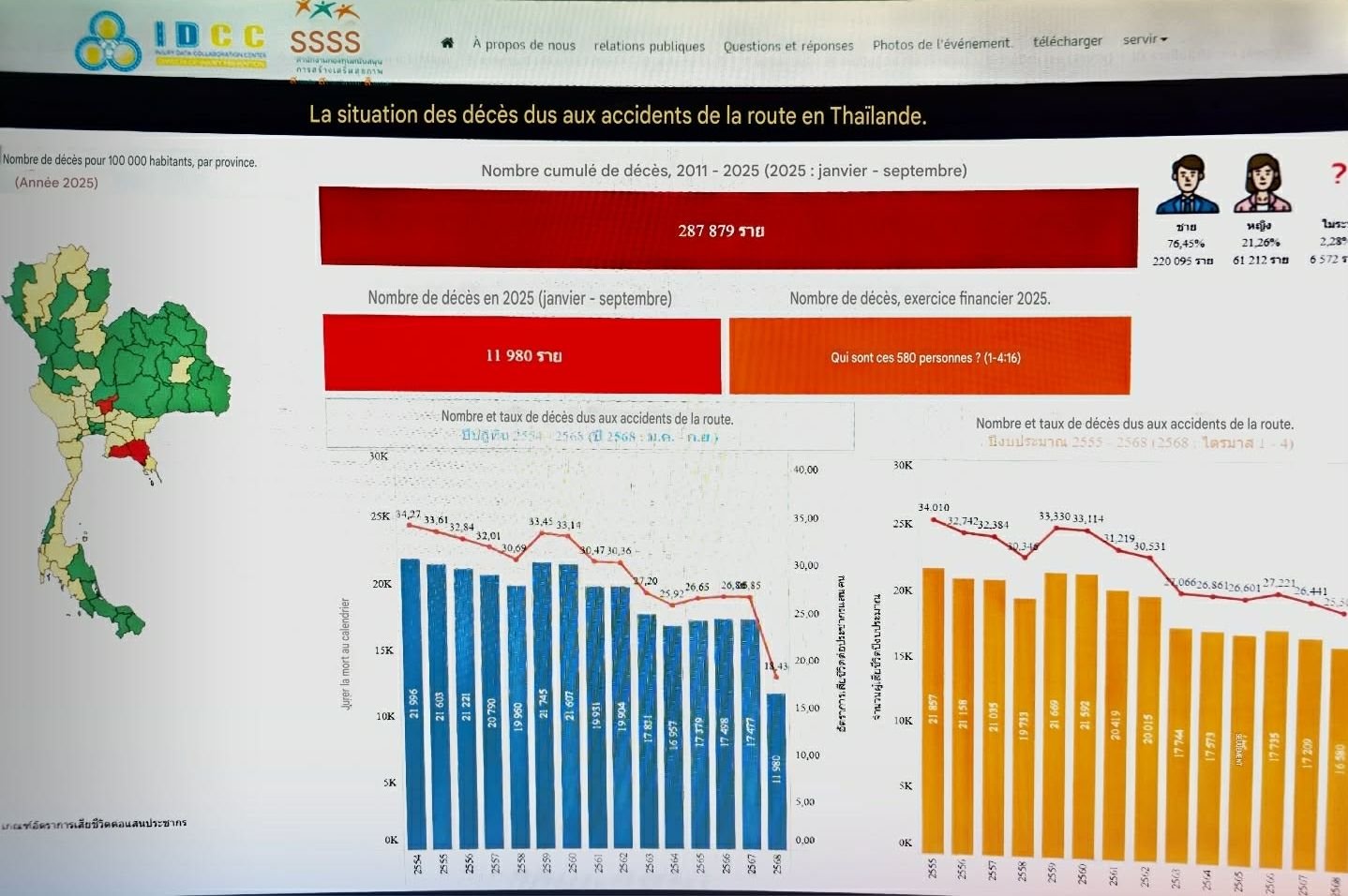
I'll start with the most important question: personal safety. Isn't driving in Thailand a bit suicidal? As a reminder, there are over 20,000 road deaths in Thailand every year on average, which is more than 50 deaths per day. Enough to make anyone think twice! (Sorry for the dark humor.)
To put all this into perspective, Thailand loses an average of 300 to 450 lives per week on the roads, the equivalent of a small rural village disappearing, and a small town every year… A sad fact that regularly places Thailand in the top 10 of the deadliest countries on the roads according to the WHO.
Many accidents, around 75% on average, involve motorcycles. Yet, how many people still ride without a helmet? Tourists included… Fewer than before, but still too many, with poor-quality helmets and, worse, helmets not fastened, therefore useless…
Otherwise, the causes are often the same as in other countries:
- excessive speed (quite striking in Thailand)
- driving under the influence of alcohol or other substances
- the failure to wear a helmet or seatbelt (which is mandatory in Thailand)
- drivers distracted by the use of mobile phones or other
- roads with sometimes dangerous infrastructure (although I think there are significant efforts being made in this area)
- dangerous vehicles, particularly overloaded pickup trucks or lorries
However, all of this could be corrected quite "simply" by simply enforcing the law. The highway code does exist, but daily checks are very inconsistent and compliance is highly uneven.
One day they check for helmet use, the next day the same person walks past the police who aren't there to block the road, and suddenly, nobody cares…
However, the latest statistics seem more encouraging, with an apparent decline, proof that attitudes may be starting to change a little.
What's it like driving in Thailand?
Having made that necessary disclaimer, let's get to the heart of the matter. You've probably already heard about the chaotic streets in Asia, teeming with life, with all those two-wheelers weaving between the cars, and you're thinking: "Whoa, that's not for me..."
I understand. And it's enough to make anyone who's already uncomfortable at home feel uneasy. Here's a first piece of advice: if you're not a fan of driving, it's best to opt for public transport or hire a private driver.
If you've never ridden a scooter in your life, forget it. It's a very bad idea to start in a country whose driving rules you don't know, even if the whole point here is to try and understand them.
The first real change: driving on the left
The first major change in Thailand is quite obvious: driving on the left.
Unless you've already had experience driving in a country that drives on the left, it might seem trivial, but changing sides completely alters our perception and reflexes regarding road use. Typically, this means starting to enter a roundabout the wrong way… even though they are rare in Thailand.
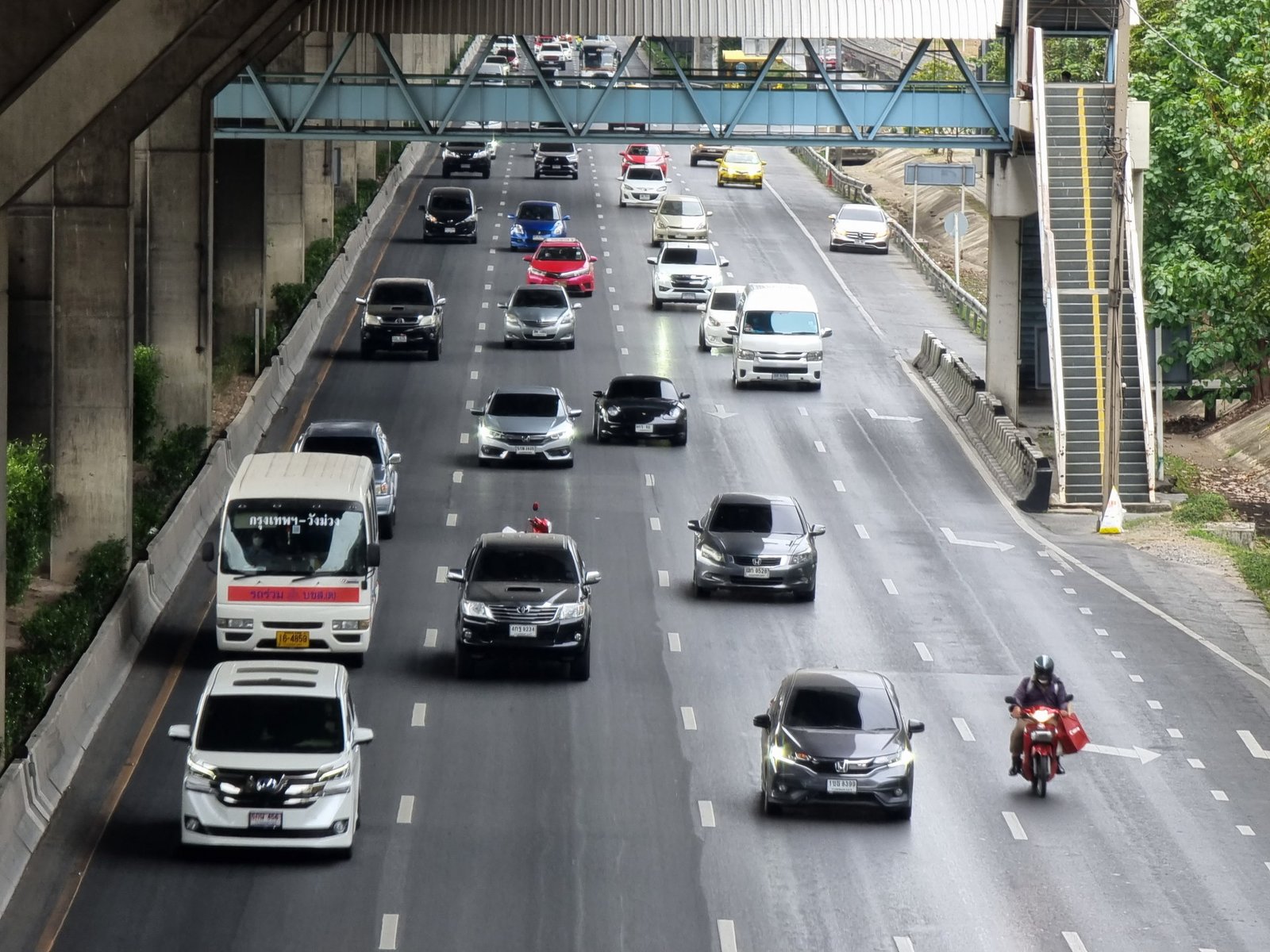
An "organized mess"
The Thai driving style can be summarized as follows: the goal is to get from point A to point B quickly and easily, sometimes with a little bit of fun. Considerations of the law or safety standards are often a distant second.
Driving the wrong way instead of going an extra 500 meters? Easy. Riding four people on a motorcycle instead of taking public transport? No problem. Waiting at a red light? Why bother! I have time to go! This last point is especially true for motorcycles.
Ironically, for a people generally perceived as "cool," Thai drivers are extremely impatient, sometimes even more so than Parisians. Even though traffic lights usually display the waiting time, seeing that you have to wait 20 seconds or even 5 seconds at a red light? No way, too long!
To give you an idea, at an intersection it can look like this: in barely 1 minute, no less than 13 motorcycles run the red light with complete impunity.
Driving in Thailand is what I call "organized chaos". In a way, it's chaotic, since the driving rules are quite vague, priorities are not always obvious, and there are people who tend to come from everywhere, especially motorbikes.
It's not necessarily easy, at first glance, to understand how things work and the "road customs" in Thailand. Yet, it's essential if you want to avoid ending up in the hospital, or worse.
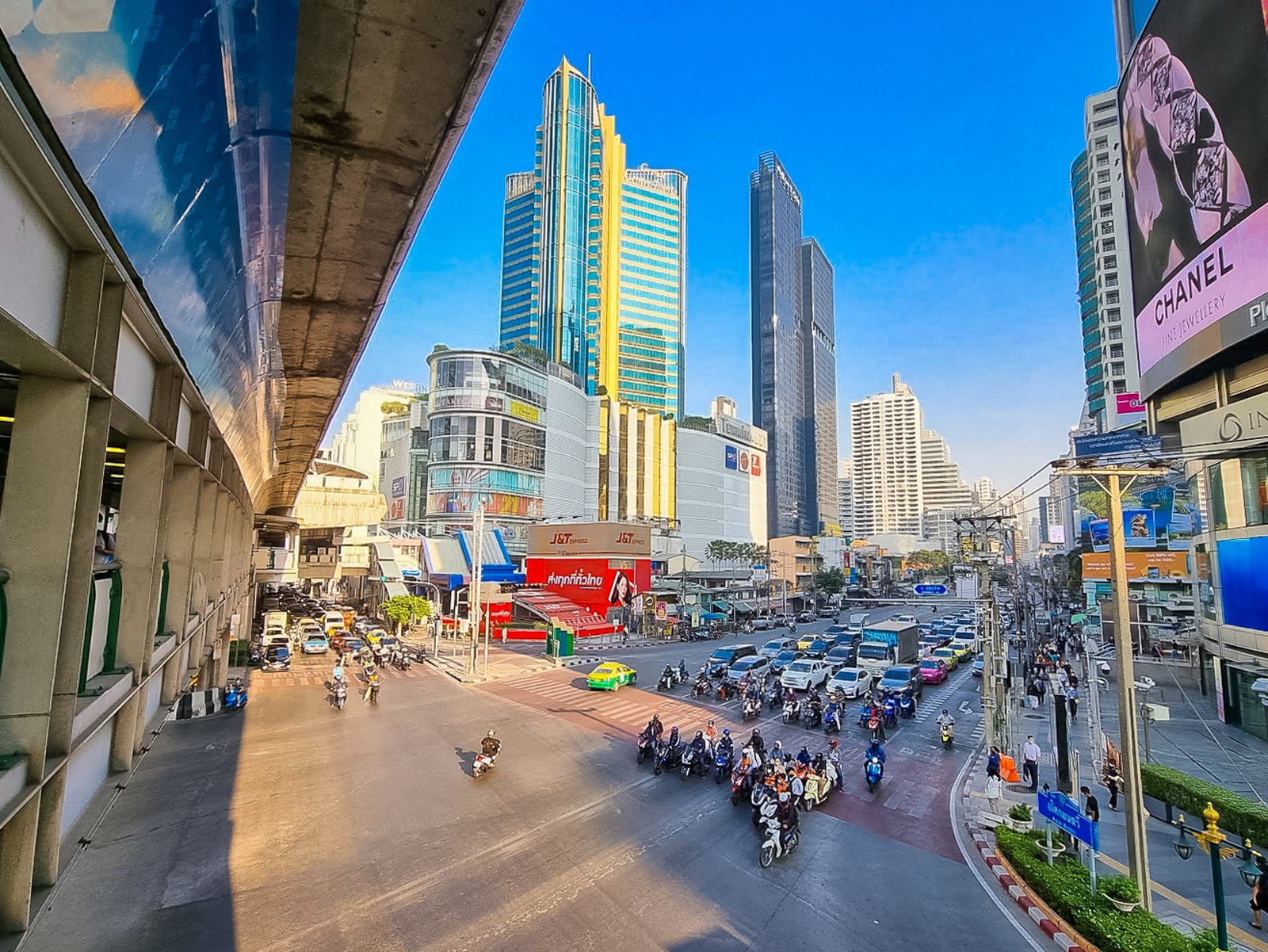
But having gotten my license here, I understand quite well why there's such chaos. The rules are clearly not well learned, there are no proper driving schools like in Europe, and even less so for scooters, where many learn "on the job" on their parents' bikes, sometimes from the age of 10…
There is clearly a lot of work to be done in driver education, as drivers are somewhat left to their own devices on the roads after a rushed and easily obtained driving test…
Typical situations to anticipate
Then there are situations that may seem dangerous, but to which your reaction must remain thoughtful. It is not uncommon, for example, to see a car approaching from the opposite direction while blithely overtaking another vehicle, when you are not far from passing each other.
Above all, don't panic. It's confusing, and in this situation, there's nothing wrong with flashing your headlights if the maneuver is too dangerous or too close to you—a way of saying, "Get out of the way!" But since roads are often wide in Thailand, it's common practice to move to the left and let the driver finish the maneuver.
The important point is to check, in doing so, that you are not going to obstruct a motorcycle traveling in the left lane.
As I mentioned earlier, it's also not uncommon to see two-wheelers going the wrong way, parked on the sides of the road. Okay, even then, you can see them coming. The worst are those who come barreling in from the side of the road, from a street or road perpendicular to the main carriageway, thinking, "It's fine, I'm not wide, I have room to get through," even as you're approaching the intersection.
In theory, yes… it will work… most of the time. Except that on the one hand it is surprising, and on the other hand, the reflex is often to move to the right, forgetting to look if someone is coming from the opposite direction or overtaking us if it is a dual carriageway.
In the city, you have to be particularly vigilant about this and really keep your eyes peeled. Another point: turn signals are often "forgotten," so you easily find yourself braking suddenly because the person in front didn't bother to signal that they were going to turn.
And overall, it's a bit of a case of the biggest dog, so beware of trucks, buses and vans: they are the cause of many accidents.

Risk periods and situations
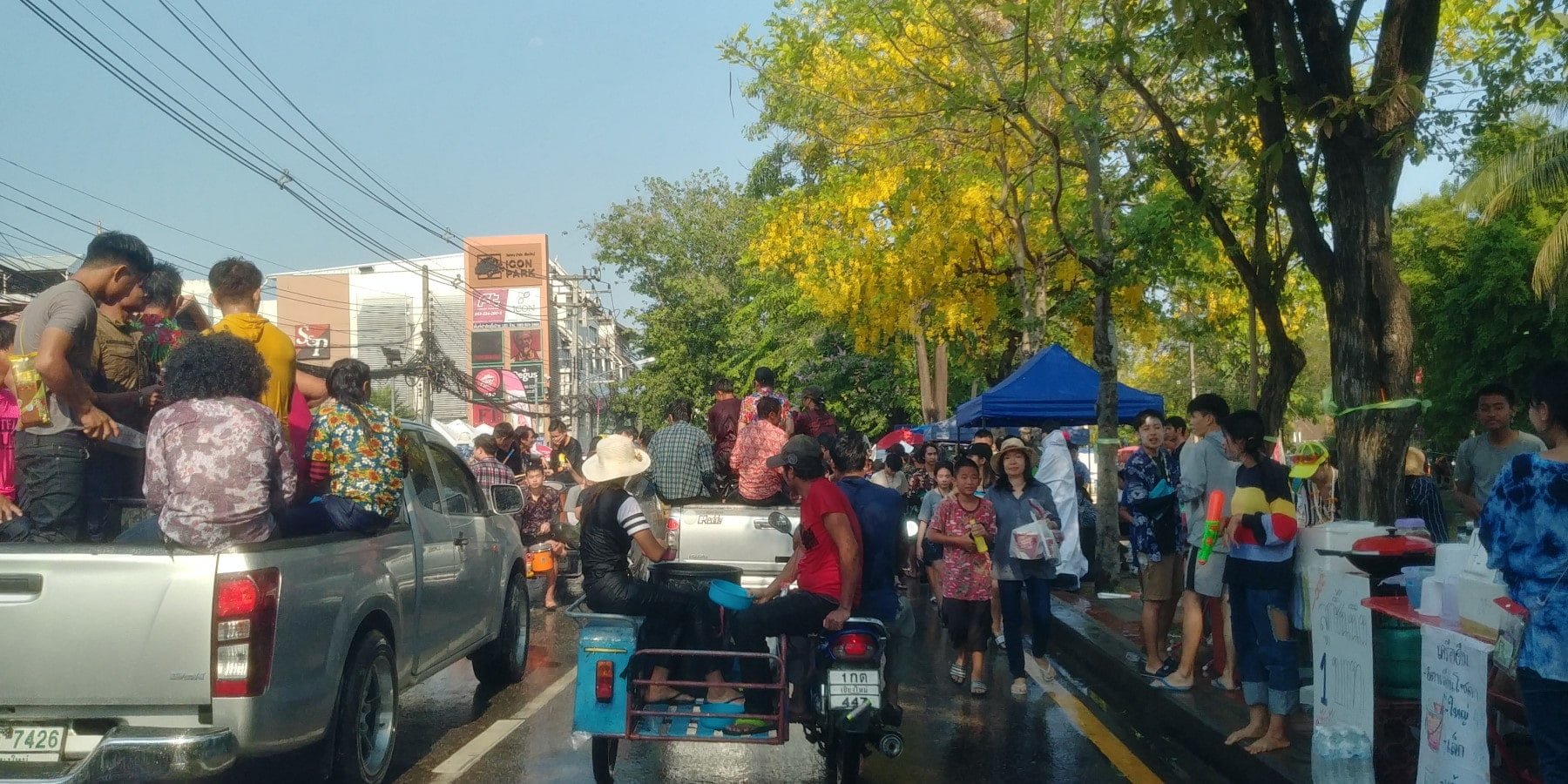
Be aware that certain periods are obviously more risky. I'm thinking particularly of New Year's, whether it's December 31st or... Thai New Yearwhich takes place around April 13, 14 and 15.
The festivities naturally lead to the kind of behavior you might expect, including letting loose and alcohol, which necessitates greater caution. Locally, they even call it the "Seven Dangerous Days." Consider yourselves warned.
Also note that, especially in the north, you will regularly come across police checkpoints, marked by cones and a triangle with the police symbol on the side and in the middle of the road, sometimes with a flashing light.
Slow down; you won't have much choice anyway, but if stopped by the police, hand over your vehicle registration and driver's license. If everything is in order, there shouldn't be any problems.

There are good points, though.
The advantage of Thailand, however, is that all of this happens in relative silence. There's very little honking, which is a good thing. If you've ever been to Vietnam or India, you know what I mean… Noise is exhausting.
Furthermore, many vehicles use automatic transmissions, which makes things much easier and allows you to concentrate better on the road. The same goes for two-wheelers: if you're not comfortable with a "pure" motorcycle, most 125cc models are automatic or semi-automatic, so there's no clutch, just gears to shift directly with your foot.
Another advantage: the road conditions are generally quite good. Finally, there are also some appreciated courtesies, such as moving to the left to let a faster vehicle pass from behind, or trucks briefly signaling that you can overtake them when your visibility is limited.

The holiday effect
The main problem remains a certain laxity, which sometimes leads to dangerous situations. Although this largely depends on one's own driving style and especially where one is driving. For example, it is much easier to drive on the plains of central Thailand and the countryside of Isan (northeast), which often offer good visibility, than on the winding roads of northern Thailand.
But by laxity, I also mean all those people who will use the excuse of—because "that's how Thais do it"—and because it's the holidays, forgetting some essential basic rules. And here, I'm talking especially about two-wheeled vehicles.

I'll ignore those who ride around shirtless on scooters, The biggest drawback is wearing a helmet. And there are many in the south, more than anywhere else, who sport the wind-blown hair look. I always struggle to understand how something that is automatic (albeit out of necessity) for us is completely ignored as soon as we go elsewhere.
Actually, yes, we'll call it the holiday effect.
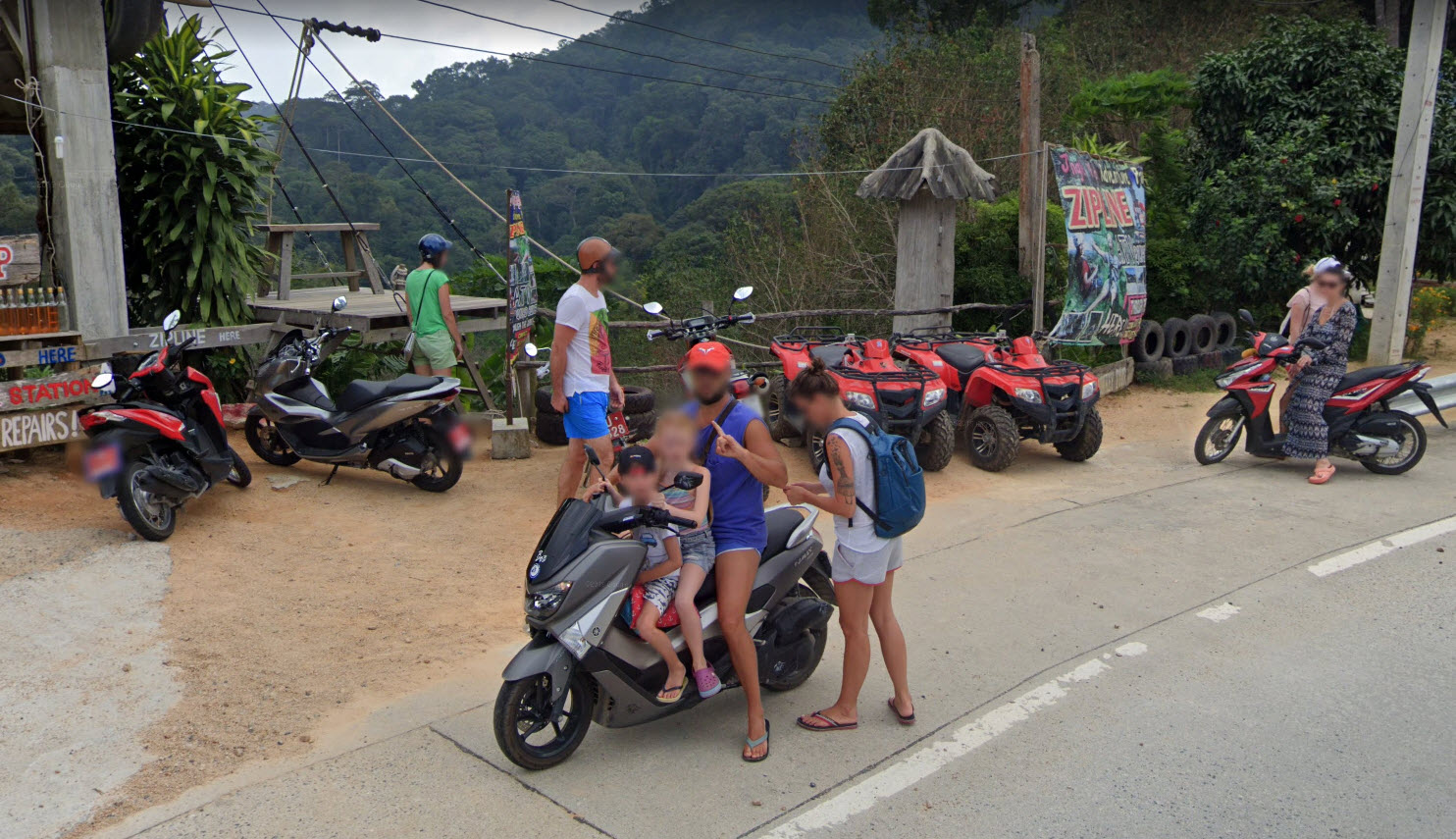
Even worse is when I see families, 3 or 4 of them, with their toddlers sandwiched between the adults… without helmets… and yes, there are some!
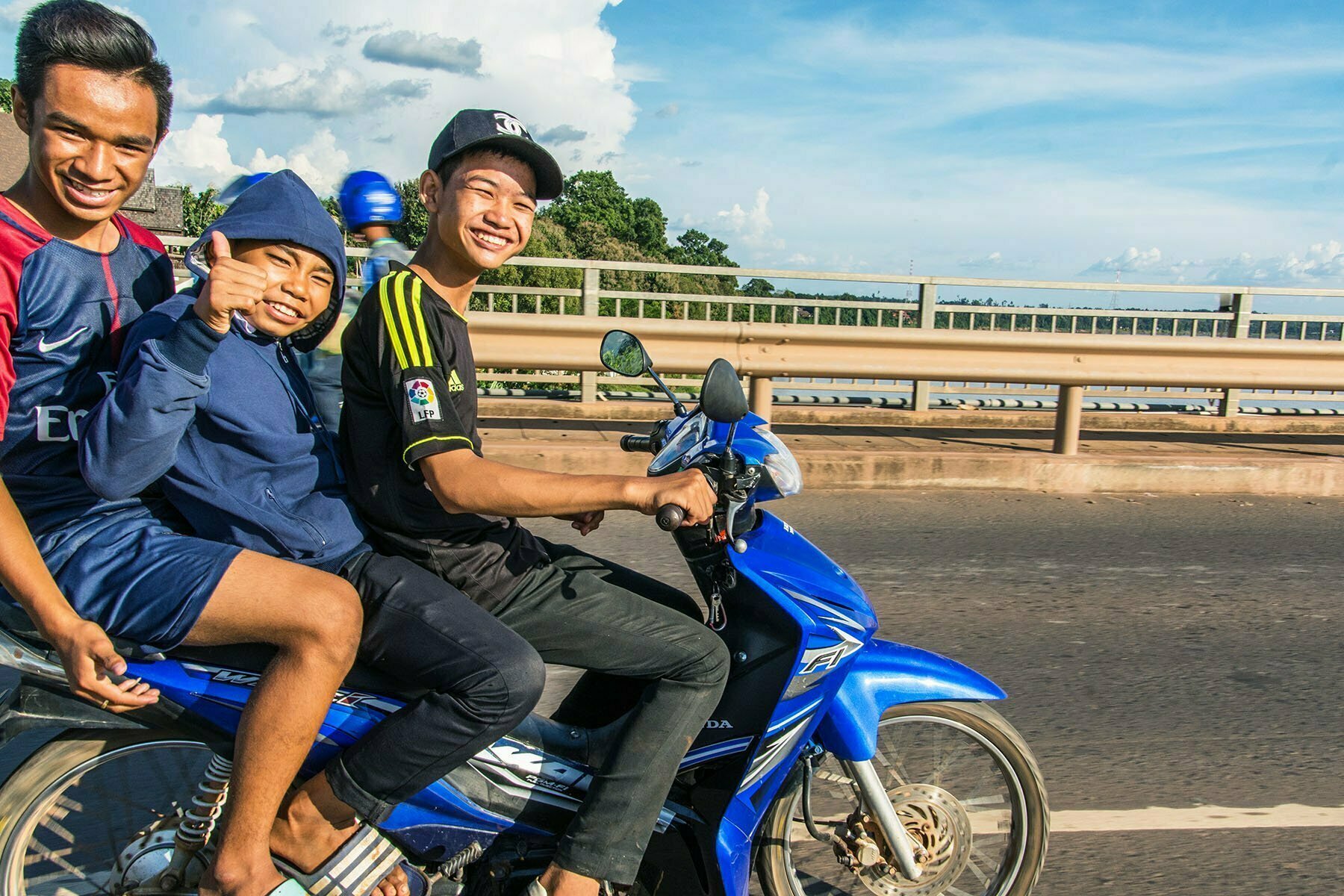
I would like to reiterate: Helmet is MANDATORY in Thailand! And be aware, there are more and more checks in tourist areas. Don't go saying the police are targeting you just because you're a foreigner, even if that can happen on islands or other heavily touristed areas, but if you're not in compliance with the law (and many aren't), it's normal to get a fine.
The worst part for me is the phenomenon of imitation. We hear so much about scooters as the ultimate mode of transport in Thailand that some people, out of sheer stupidity I have to say, decide to drive a vehicle they don't know how to handle. It's unfortunately common to see people renting a scooter, at least a 125cc one, for the first time in their lives here in Thailand… I'll let you imagine the scene.

Avoid possible scams
Without becoming paranoid, we shouldn't ignore the fact that scams do exist in Thailand. Among the most common is the so-called "jet ski scam," which is widespread in tourist areas like Pattaya and Patong.
But this scam can also apply to scooter or motorcycle rentals, and to a lesser extent to other vehicles.
So what does it consist of?
They simply try to make you pay for repairs for scratches or damage that were already there. This scam relies on two fairly simple elements.
First, many people don't check the vehicle before picking it up. The solution is quite simple: take two minutes to walk around the vehicle, or better yet, take photos. A rental company in Chiang Mai was actually the first to ask me to do this, a testament to their professionalism. This is also why this scam is less common with cars, as inspecting the vehicle before pick-up is normally part of the procedure.

Then there's the pressure exerted on the individual, who is often disoriented when surrounded by several people determined to get what they're owed. This pressure is all the more effective because many leave their passport as a deposit, as this is often required by two-wheeler rental companies.
And without a passport, you quickly find yourself stuck. So, in most cases, people pay. Sometimes exorbitant sums, up to 20,000 baht, or even the price of a new vehicle…
Next, choose well-known places, do some research online to find a reputable shop if needed, and also rely on word of mouth.
Rent a car or scooter in Thailand
Obviously, solo travelers and couples often prefer a simple, practical, and inexpensive mode of transport. And for that, the scooter perfectly fulfills these three criteria. Enjoy freedom, easy parking, and the ability to travel as you please. All of this is appealing, which is why this option is so popular in Thailand, especially on the islands.
However, I reiterate what I said earlier: I definitely don't recommend that beginners try riding a two-wheeler upon arriving in Thailand. If you lack the basic skills and the ability to handle such a vehicle, Asia is clearly not the place to hone your skills.
To draw an analogy, it would be like saying to a beginner skier: Come on, let's do the black run! »

There will always be those who recount their experience, which for many went smoothly, with advice that can be summed up as "go ahead, don't worry, it'll be fine in a few minutes." Except that an accident can happen faster than you think.
How many times have I seen Leetchi or other crowdfunding campaigns to try to pay hospital bills which, without adequate insurance, because you need a motorcycle license (see below), climb very quickly.
See an example here, which teaches us in passing that in Ko Phangan, for example, no less than 500 tourists die each year, or more than one per day.
Renting a car is certainly more expensive and parking will be more complicated, but it's clearly safer. Especially if you're traveling as a family, it's a much more sensible option than trying to recreate the Thai experience with three people on a scooter, the little one in front as a makeshift airbag…
What are the conditions for renting a vehicle in Thailand?
What you need to rent a vehicle in Thailand:
- An international permit. Since March 3, 2026, the application process has been entirely digital via the ANTS / France Titres online service and cost 7,25 € For processing and delivery, you must complete the online form, upload the supporting documents, pay the fees by credit card, and then track the progress of your application through your account. The required documents include: proof of identity, proof of address less than 6 months old, a valid national driver's license, and a digital passport photo less than 6 months old in e-photo format. It is therefore best to submit your application well in advance of your departure.
- A copy of his passport or cash for a deposit, ranging from 3,000 to 10,000 baht depending on the vehicle
- A credit card, or at the very least a deferred debit card, for car rentalbecause it is used for the deposit
Scooter rental
This is where an important point needs to be made: in Thailand, driving a scooter is not a simple matter of having a car license. Even for a small model, You need a motorcycle license corresponding, in addition to the international driving permit.
If you do not have a motorcycle license, you will see that only the stamp concerning driving a car will be validated. A1 permit A license obtained through equivalency with a category B license is only valid in France. This French exception, allowing the holder to drive 125cc motorcycles after two years with a category B license (provided they complete training), is not recognized in Thailand and therefore has no legal standing here. Many people are still unaware of this, or choose to ignore it.
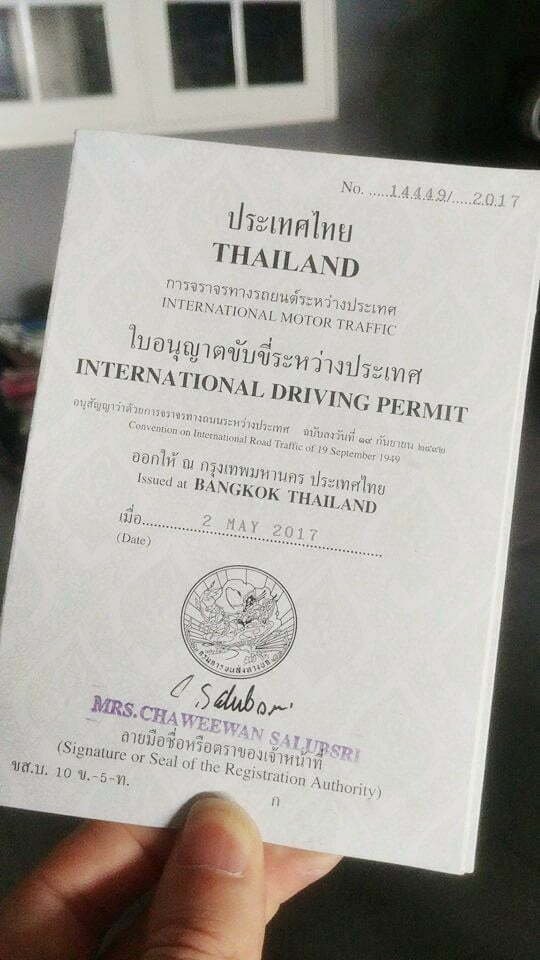
As I mentioned earlier, in practice, few rental companies systematically ask to check this point. For them, it's not their problem, as long as they're renting out their equipment. However, for the police, or especially in the event of an accident, it can quickly become a problem.
But be careful: I want to reiterate that if you rent a motorcycle without the proper license, your insurer is not required to cover you, since you would be at fault.
In any case, carefully check what your travel insurance covers before hitting the road, especially if you plan to rent a two-wheeler in Thailand. It's the kind of detail you often only discover too late. If needed, here's the one I recommend:
I recommend you Heymondo Travel Insurance (5% discount via my link).
Transparency: if you subscribe via this link, I will receive a small commission — at no extra cost to you.
In this regard, some reputable rental companies are now starting to check and refuse first-timers and other beginners. It would be good if this became standard practice, but unfortunately, the requirement for these individuals to check their licenses BEFORE renting hasn't yet become commonplace (I think we'll get there eventually).

Regarding the police, while it usually only amounts to a fine, up to 1,000 baht in this case, and above all a waste of time, it's still better to anticipate the situation and avoid it altogether. After all, you don't go on vacation to end up at a police station, much less break the law.
Assuming you're comfortable riding a two-wheeler but don't have a motorcycle license, at the very least, make sure your insurance covers you in case of an accident. Some insurers may cover you as long as you have a national license along with an international driving permit, even without a motorcycle stamp. But personally, I advise you to be cautious and wouldn't rely on it too much.

In any case, I know it's hot, I know the basic helmets provided are often really terrible, but wear one. It's not only mandatory by law (even if it's not always obvious, who comes abroad to flout local laws!?) but it can also save lives.
I can't help but make this little remark; I imagine that in France you wouldn't allow yourself to ride without a helmet, so why allow yourself this freedom abroad (if it were legal in itself I wouldn't say anything, but it isn't!).
Alternatively, if you plan to seriously explore the country on two wheels, you can find full-face helmets in large supermarkets or specialist stores if those provided by the rental company are too low-end.
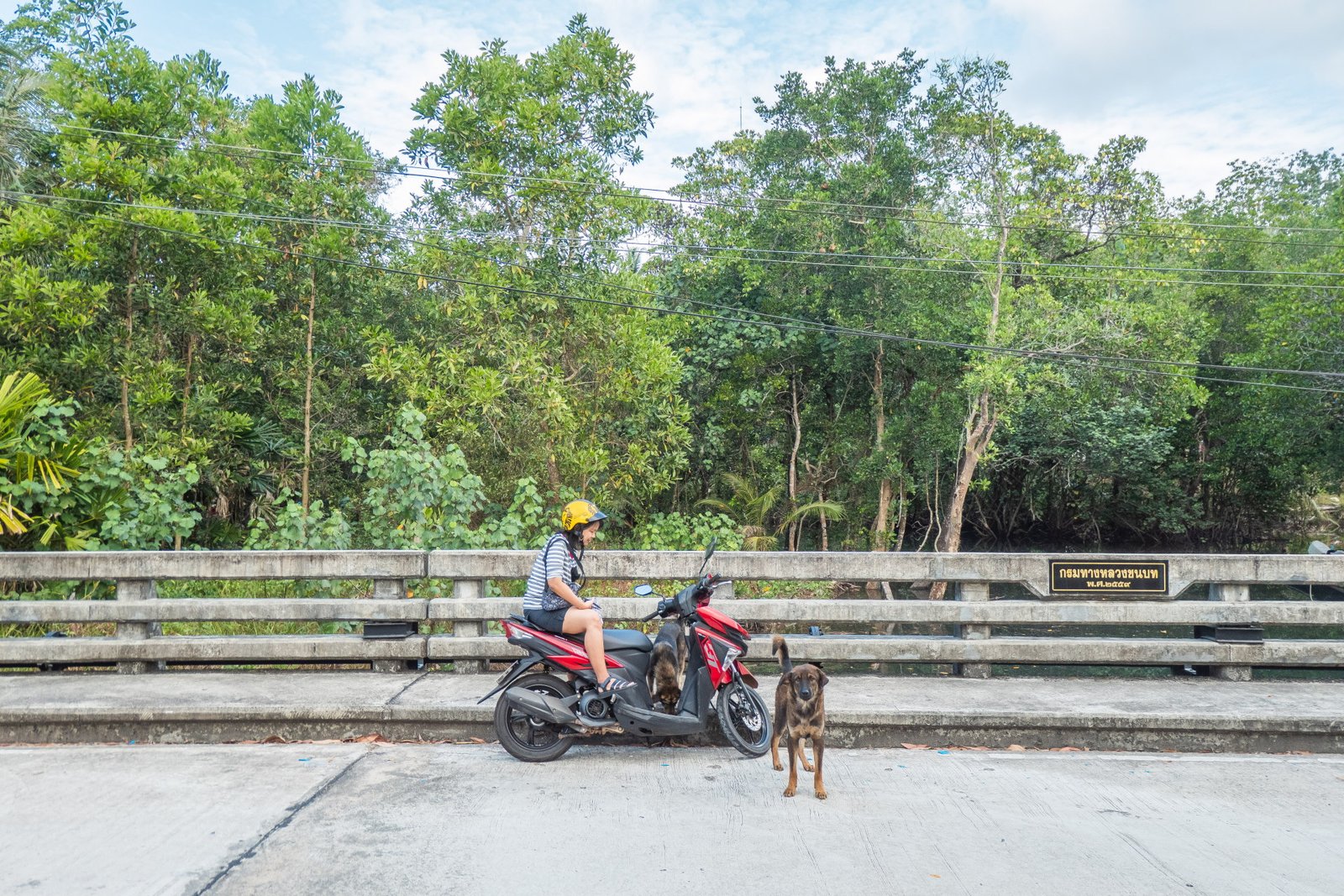
Regarding the second point, and this relates to the previous paragraph, you should not leave your passport as collateral. Firstly, because it's illegal, but also to avoid finding yourself in the situations mentioned above, such as scams.
So what should you do? Offer a photocopy of your passport, which you should absolutely carry with you during your stay, as it's much more practical to have one in case of loss or theft, rather than the original. And if the rental company refuses, find another location, or ask if it's possible to pay the deposit in cash instead.
This is generally the best solution. In the case of a photocopy, it is common for the rental company to also ask for a cash deposit.
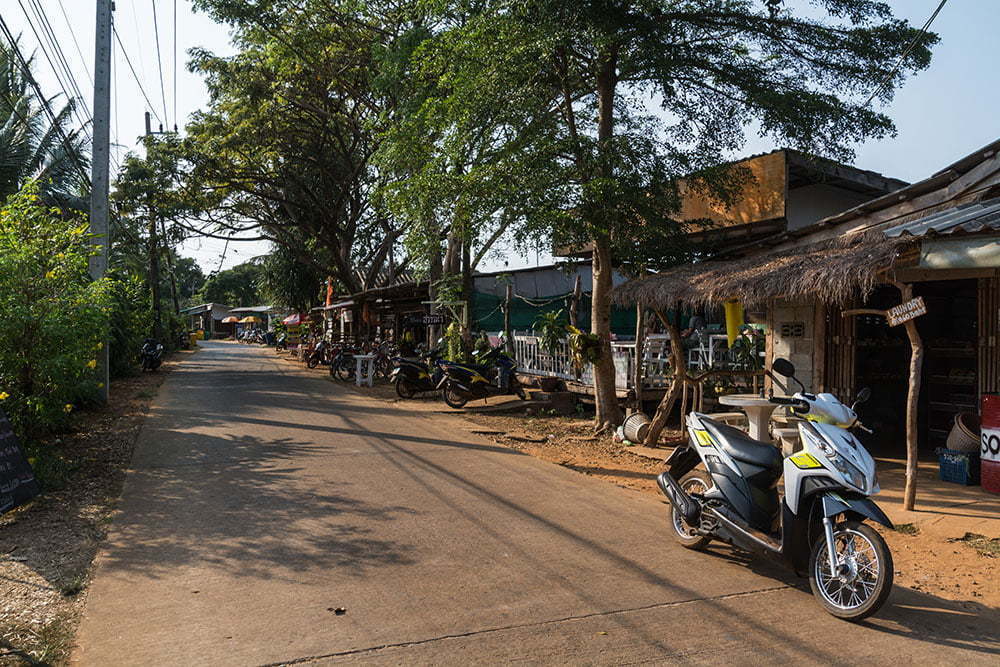
Opt for rental companies with a good reputation rather than the first one you come across. Reputable companies generally meet the requirements: no passport confiscation, cash deposit, motorcycles in good condition, etc. Here are a few recommended companies in the country:
- In Ko Samui :
- Tonton Rental, run by a Frenchman, has an established reputation. It offers both motorcycles and cars: https://www.tontonsamuirental.com/
- Jungle Wheels Samui Motorbike Rental is also a shop run by French people. It's brand new, as are their scooters, so the equipment is impeccable. https://www.facebook.com/JungleWheelsSamuiMotorbikesRental
- In Ko Phangan :
- Phangan Wheels, a reference on the island: https://phanganwheels.com/
- In Surat Thani, on the mainland side, on the Gulf of Thailand:
- Deer Motorbike Rentals : https://www.facebook.com/Deermotorbikerentalssuratthani/
- In PhuketThere is a wide range of choices, many of which are located in Patong:
- Rental Motor Patong : https://rentalmotorpatong.com/
- ET Motorbike Patong: https://etmotorbike.com/
- Cheap as Chips Motorbike, also in Patong: https://motorbikerentalphuket.com/
- Som Motorbike Rental, based in Phuket Town: https://www.facebook.com/Som-motorbike-rental-phuket-324546611825916
- Diamond Phuket Airport Scooter Rental is conveniently located next to the airport if you don't have large luggage: https://phuketairportscooterrental.com/
- In Krabi :
- Krabi Moto Rentals, if you are in Ao Nang: https://krabimotorentals.com/
- Yellow House, if you're staying in town: https://goo.gl/maps/Lj8mBUvtdzmrCLwB7
- In Chiang Mai :
- Cat Motors Motorbike Rental, located in the heart of the old town, which I personally tested, and which does not accept beginners: https://catmotors.net/
- Mango Bikes Rent, very good reputation: https://mangobikesrent.com/
- TBR Toon's Bike Rental & Tours, one of the best options: https://www.toonbikerentalandtour.com/
- In Chiang Rai :
- Nice Rental : https://www.facebook.com/Nice-Rental
- B-rider Motorcycle Rental Chiangrai: https://www.facebook.com/bridermotorcyclerental
- In BangkokLess common, but if ever:
- Fatboy's Motorbike, which I tested once to make a trip to Khao Yai : https://www.fatboysmotorbikes.com/
- Emma Motorbike, which has a branch in Sukhumvit and another north of the city, is convenient for getting out of town: https://www.emmamotorbike.com/
- Happy Bike Day, run by a Korean: https://happykmotors.com/
Car rental
When it comes to car rental, it's much more regulated. In my case, I prefer to use international rental companies, comparing their reputations: Avis, SixtHertz, Budget, etc. Some local rental companies are also very good, so don't hesitate to do your research: Thai Rent A Car for example for Bangkok, Samui Rent Cars for Ko Samui, or Chiang Mai Wheels, a reference in the rose of the north.
An international driving permit is logically required here. Some local rental companies may still accept a national license only, but not the reputable ones. With them, the deposit is usually taken via your credit card, or failing that, a deferred debit card, and everything generally goes smoothly and without any scams.
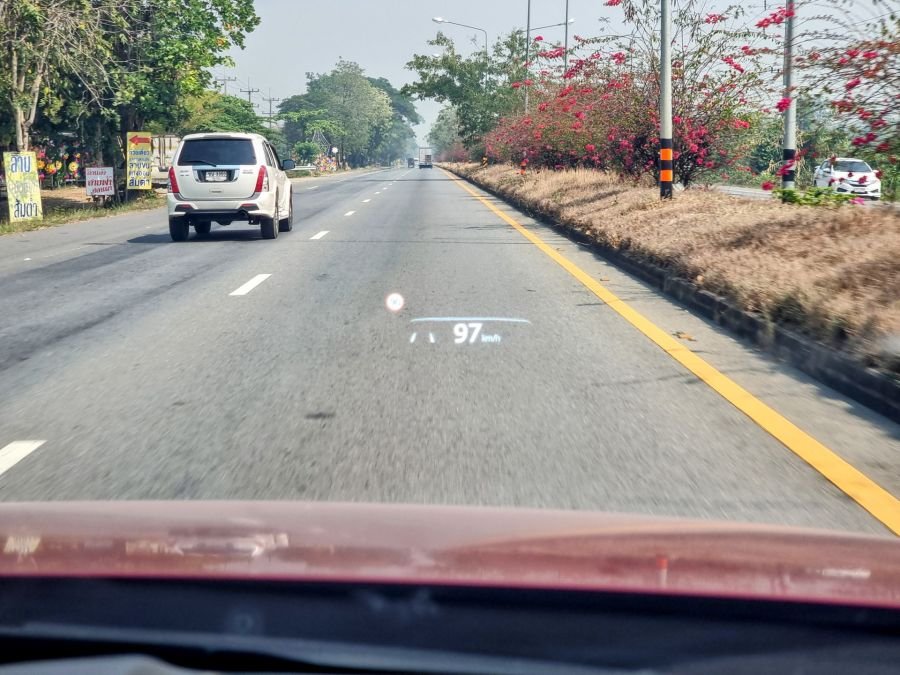
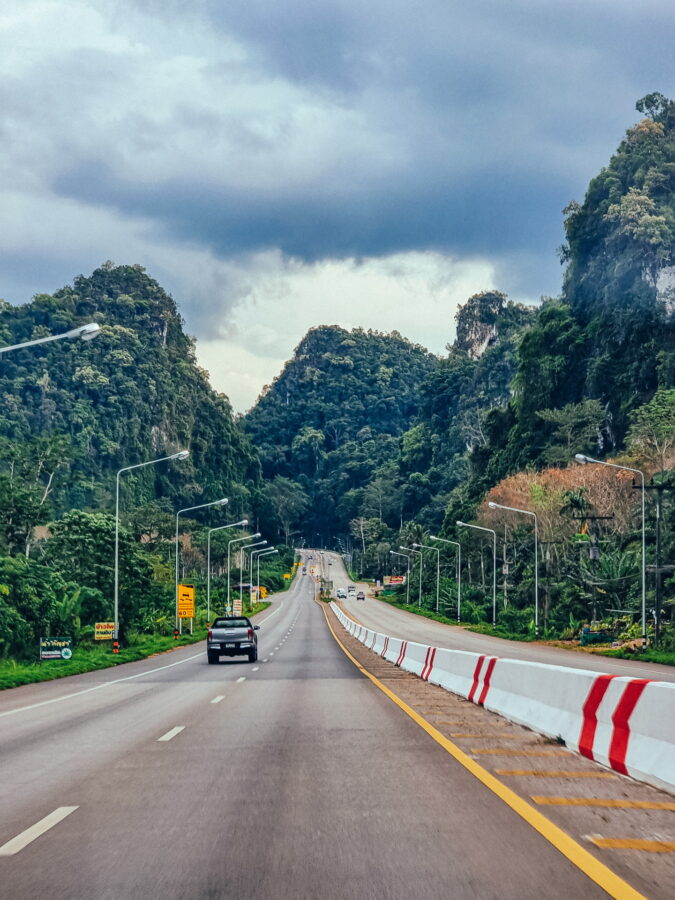
In any case, ask if it's not already specified whether you need to return the vehicle with a full tank. You'll usually see it on the fuel gauge when you pick it up: if the tank is full, there's a good chance you'll need to return it full. Don't forget to check the fuel type as well, although there's usually little chance of making a mistake (it's marked on the fuel filler flap).
Above all, find out about the insurance: what is covered, the deductibles, and the conditions in case of an accident. You never know.
On the roads of Thailand
The reward for embarking on this adventure is the ability to explore at your own pace and, above all, to truly venture off the beaten path. All you need to do is be curious, patient, and cautious.
See a landscape you like? Quick, stop for a photo. Spotted a charming little village? Why not stop there? A deserted beach? You'll often find small restaurants there. And not just by the sea: in the mountains too, you'll find cafes, often with prime locations to admire a truly breathtaking view.

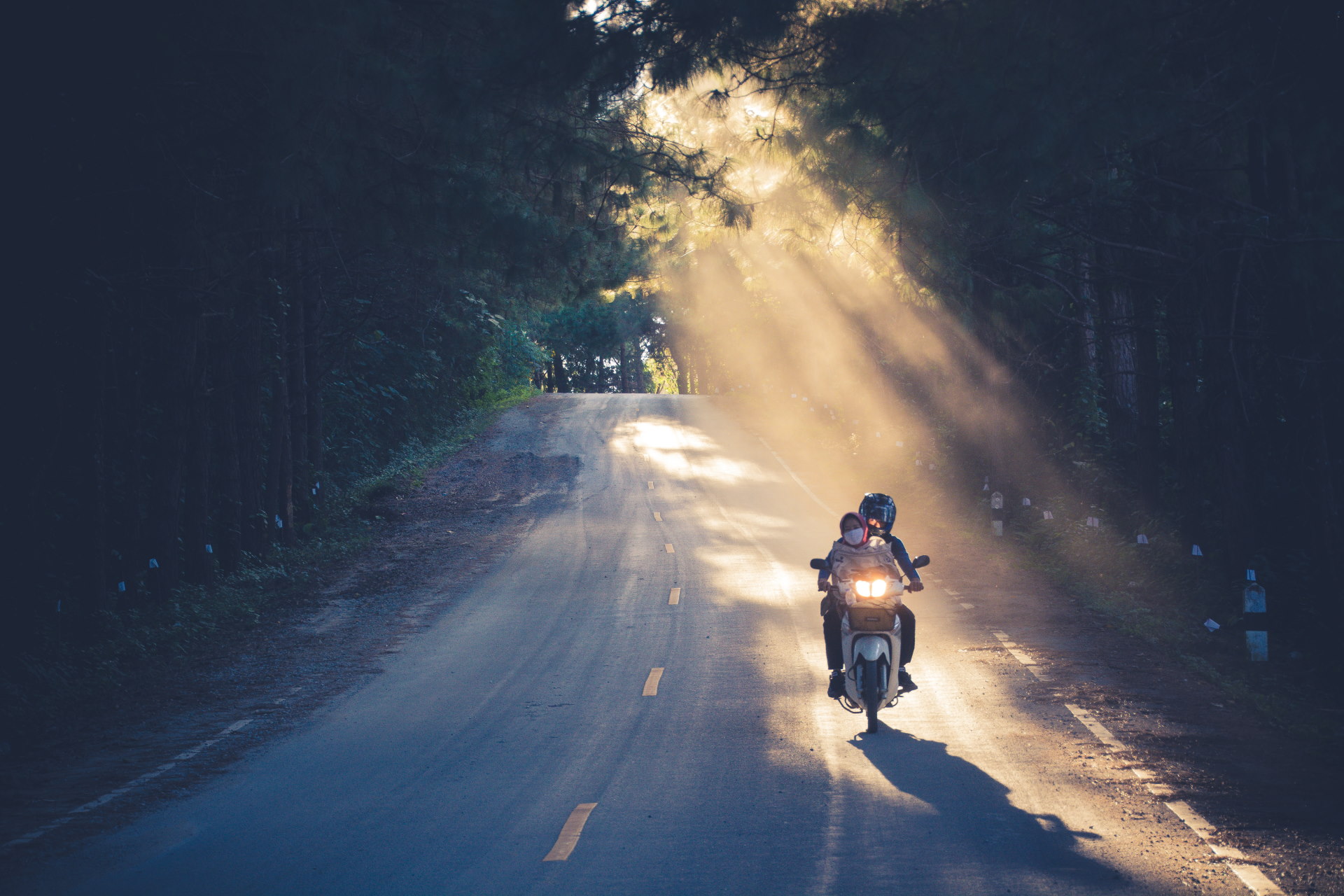
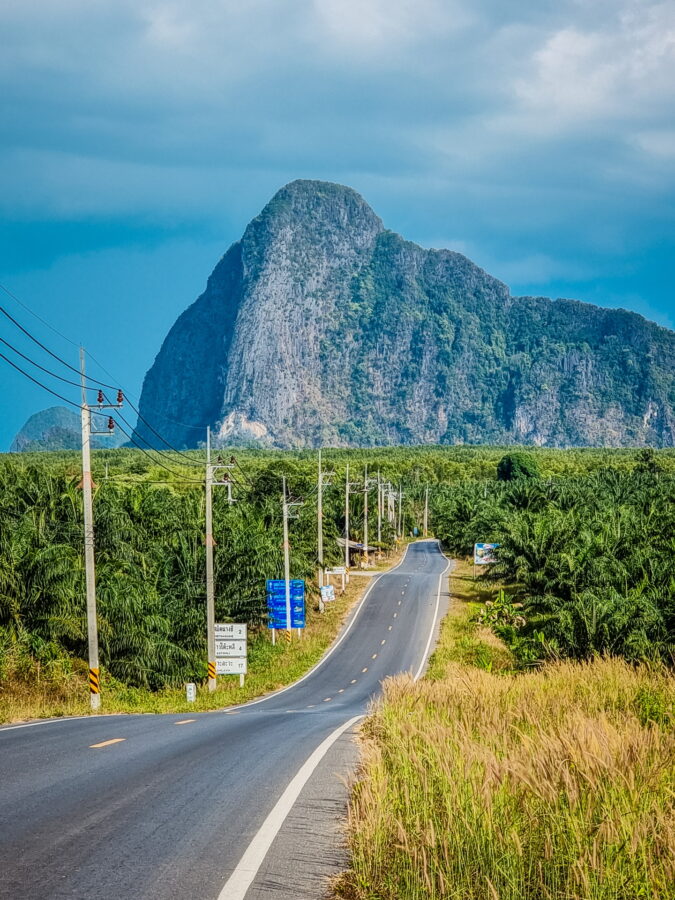
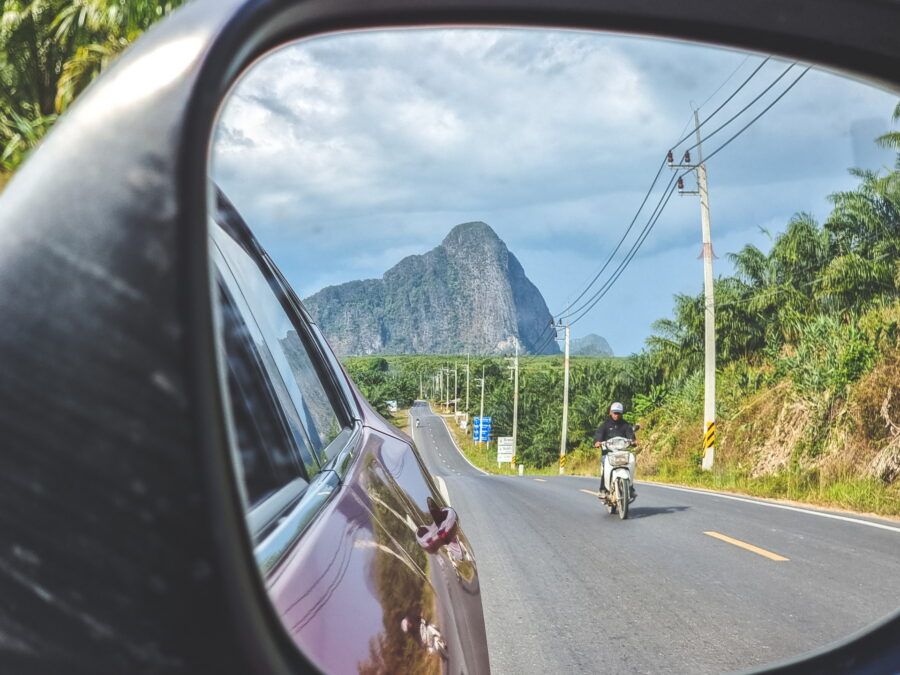
Traveling through Thailand by road also reveals another side of the country. Along your journey, you're sure to see some unusual scenes. Monkeys in the back of a pickup truck? Trucks loaded like mules, pickups piled high with over 5 meters of junk… it's all part of everyday life.
At the intersection, you'll also constantly encounter vendors offering small snacks—peanuts, doughnuts, or fruit—to motorists stopped at the traffic lights. Even more often, it's flower leis that some people hang from their rearview mirrors to ward off bad luck.


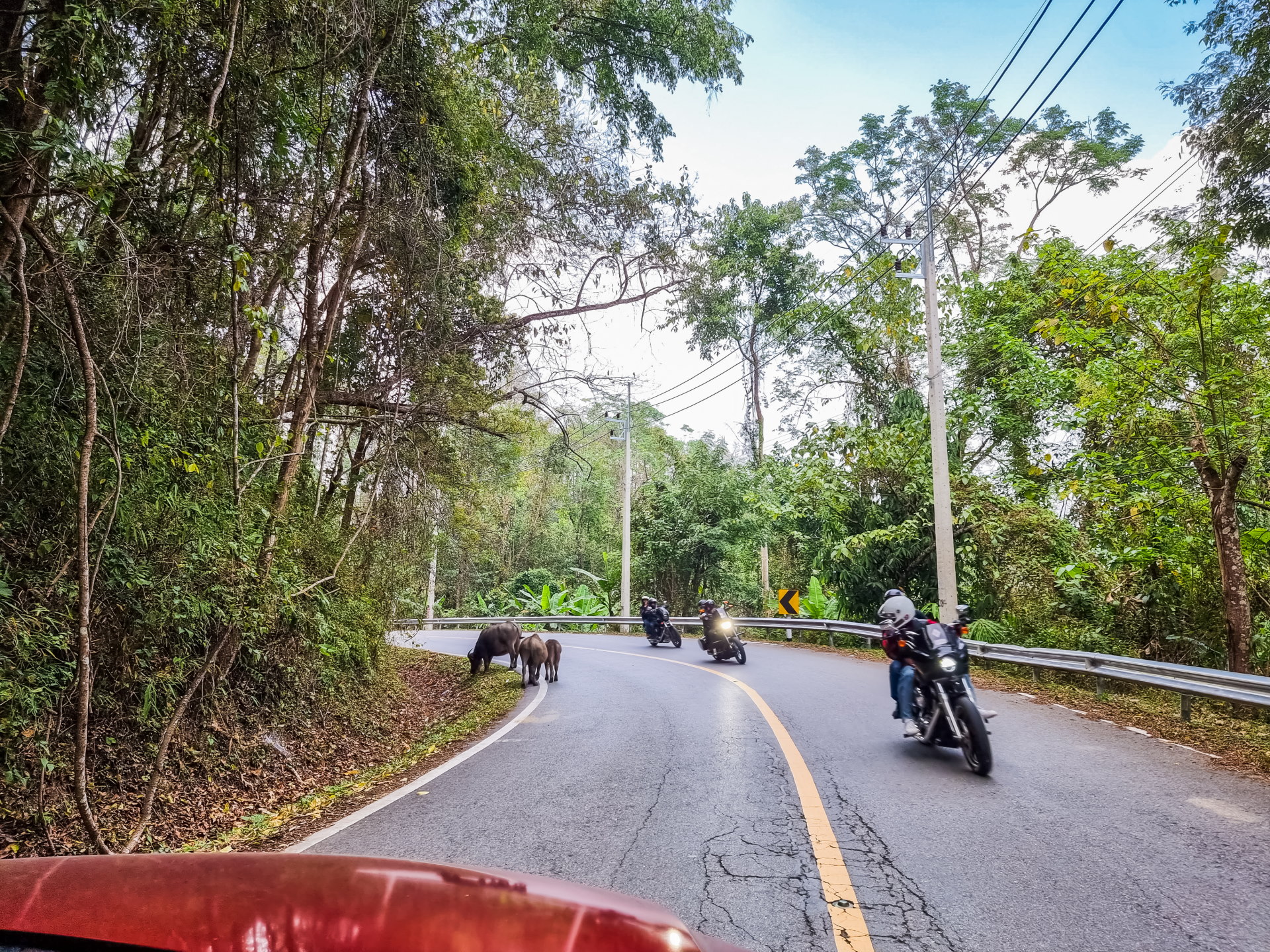
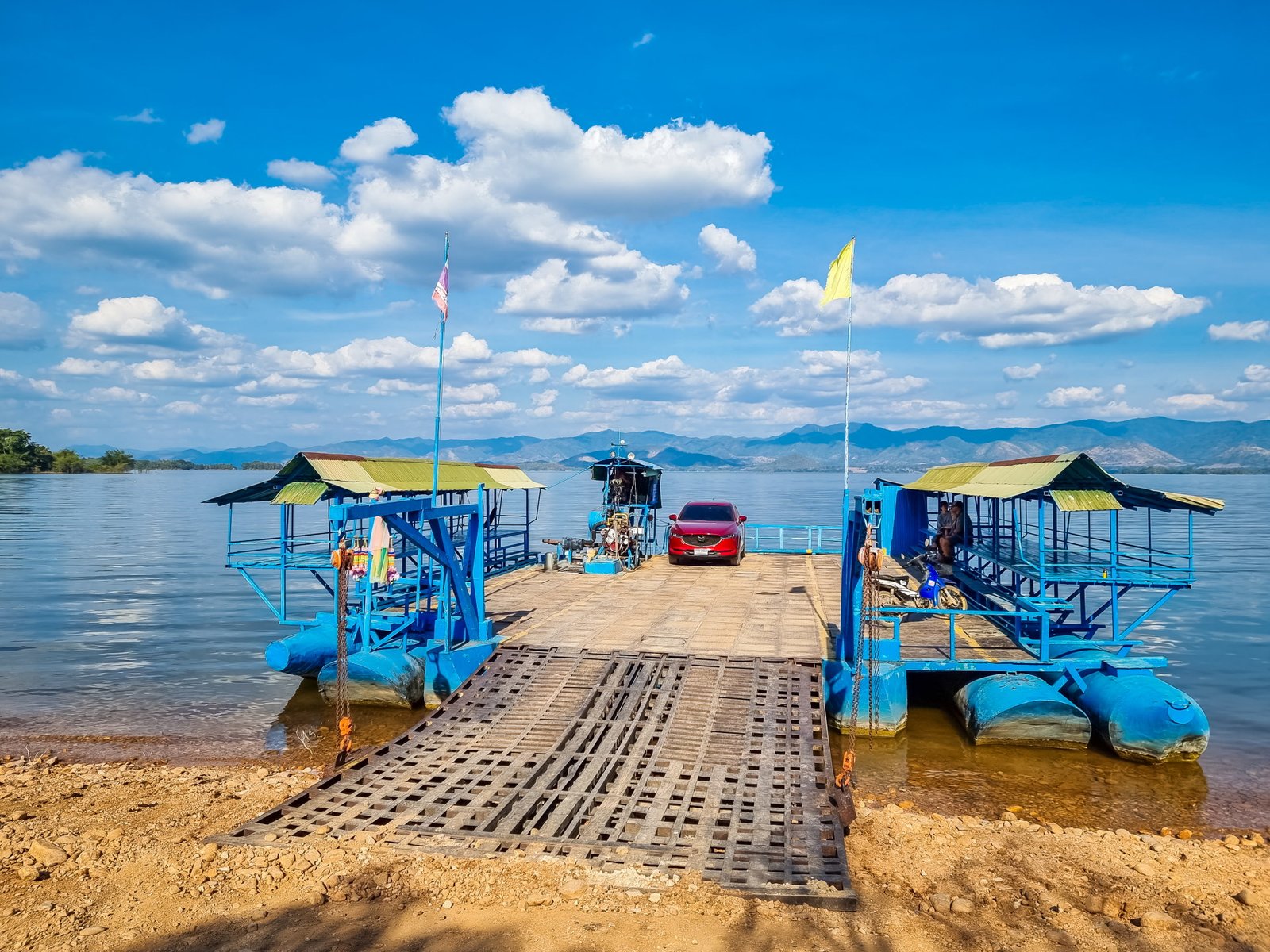
Here's an example of a great road trip you can do from Chiang Rai:
→ Doi Tung and Route 1149: Panoramas and Akha coffee in Ban Pha Hi
Before leaving
- Check your vehicle thoroughly, and take photos if necessary.
- Don't hesitate to ask the rental company questions: what to do in case of an incident, who to call, if they have local maps for the attractions in the area… all information is good to have.
- Have all your documents ready: passport, driver's license, and then the vehicle's documents once the rental is finalized.
- Check the fuel level: some scooters are handed over to you with the tank almost empty.
On the road
- Don't forget: we drive on the left.
- Even though it seems obvious, be particularly vigilant.
- Keep your cool. Losing your temper while driving is particularly frowned upon and can quickly end badly for you.
- Assume that the driver in front of you could brake suddenly at any moment because they decide to turn without signaling. This is especially true in the left lane, but it also applies to the right lane if they decide to make a U-turn.
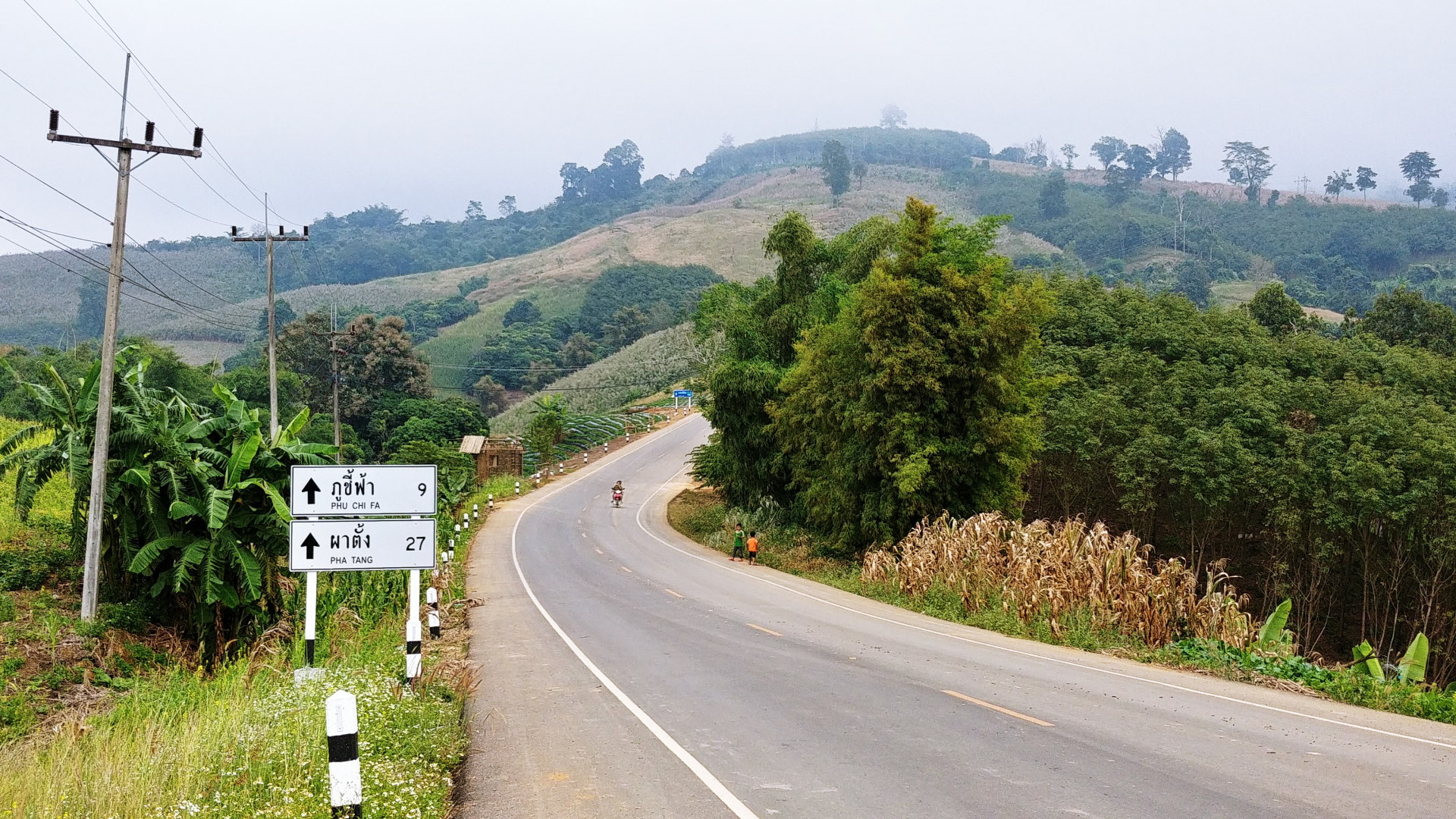
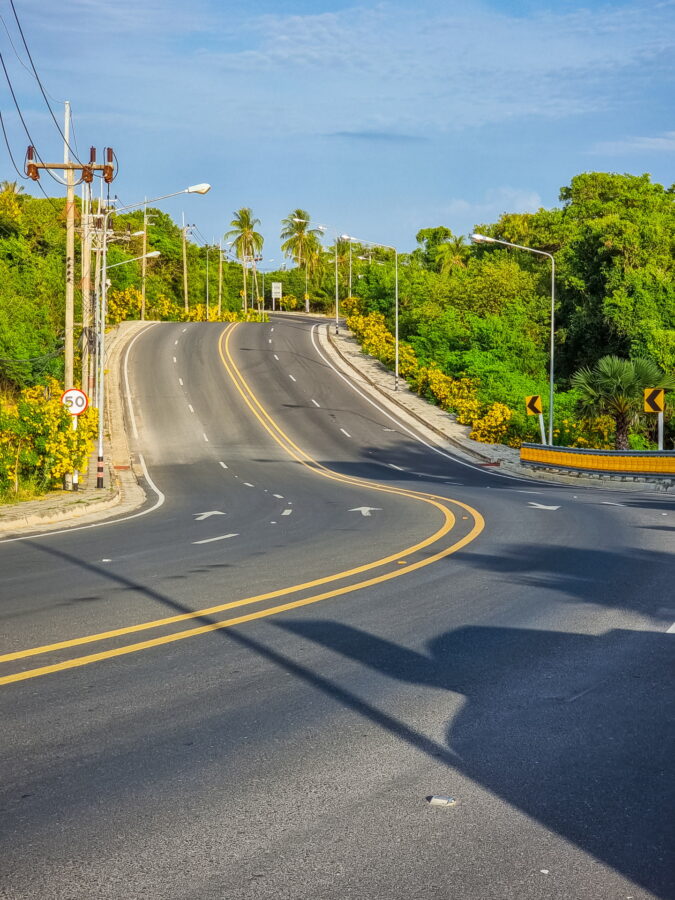
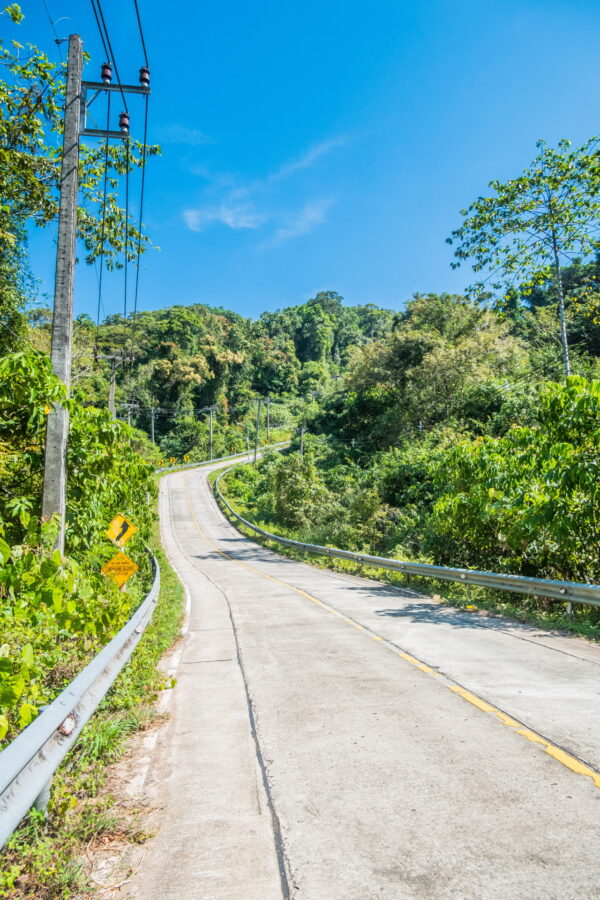
Overall, the roads are in good condition. Many of the main highways are now dual carriageway, at a minimum, or are being widened. Even country roads are generally well maintained. You really have to venture into remote areas to find roads full of potholes or completely unpaved.
Similarly, a large island like Phuket will inevitably benefit from a more extensive road network than a small island like Ko Kood. See below for the notable difference. I could let you guess, but obviously, that's Phuket on the left.
Reminder of the law
These are basic rules, which are also the norm in France:
- An international driving permit is mandatory.
- Wearing a helmet is mandatory.
- The permitted blood alcohol level is 0,25 mg per liter of exhaled air, or 0,5 g of alcohol per liter of blood.
- Speed limits are normally as follows: in town 50 to 80 km/h depending on the road, on highway 80 to 100 km/h, and on motorway 120 km/h, no more!
Note that they don't mess around with alcohol. It's not just a simple fine, which can already reach 20,000 baht, but potentially a court appearance and a criminal record. Don't take any risks, even for short distances. It seems obvious, but with the holidays, how many people forget this kind of reasoning…
If needed, use the Grab app to get a ride. There's also a feature that lets you arrange for someone to drive you instead of leaving your vehicle behind.
In general, I'll conclude with a simple point: you are here as a guest. Don't try to imitate the bad behavior of some locals under the pretext of "blending in" with the locals.
Spoiler alert: You won't be any more appreciated for it. Because even if the locals themselves can have confusing behaviors on the road, they are also often the first to complain when foreigners, supposed to have a certain sense of civility on the handlebars/wheel, think they can do whatever they want elsewhere.
So you're ready to drive in Thailand, I hope! If you've already done it, what's your assessment?

96 Comments
Hello Romain. I'm coming to Thailand at the end of October for a month and I've heard that it's possible to register a French motorcycle license (A2 or A) because I ride a 125cc motorcycle. Since I'm not very young and it's complicated to get it in France, especially considering the cost.
Could I have your opinion if possible?
I thank you. Renaux Francis.
Hello,
Unfortunately, unless you obtain a motorcycle license (the A), in good and due form, it is not possible to obtain this stamp on the international license.
It's funny how many times you use the word tourist in your comments.
As if it meant that much to you.
But one thing is that in the eyes of the Thais, you will always remain a falang and therefore comparable to those tourists that you love to look down on so much...
That's life, my friend.
What I find funny (or not…) is the way people will want to interpret words in their own way… What else do you want me to call them? Whether I use the term tourist, vacationer, backpacker, visitor or whatever, it doesn’t change the point. It refers to people passing through. The fact that I am and remain a foreigner doesn’t change the fact either, I’m not just passing through and I am therefore not a tourist in the very sense of what the definition indicates in the dictionary. It has absolutely nothing to do with looking down on them, it’s just a question of vocabulary.
@Herve
What is this contempt, this familiarity?? To be avoided, thank you.
Anyway, farang or tourist or foreigner or "Western People", it's the same...
oops, grilled…
Hello,
Having lived 2 years in Chiang Mai. I actually had my international permit but there was a problem with the decree date so it was not useful.
For the scooter no need, it is sure you have to stay vigilant. Above all wear a helmet!!!!
the best solution is to get your Thai license on site, it takes a day, it's quick and you pay...
But I share if you have an accident and you are the only foreigner you are responsible…..
and I also share you have to stay focused and be vigilant but it's very good to drive on site better than central London!! but it's fun! SABAÏ SABAÏ
if necessary ask me
but yes it is nicer to travel to Chiang MAI by train
Hello,
Once again, saying "No need" for a license for a scooter is heresy... of course the rental companies (99%) will not ask for it but it is in no way good advice... As for getting a Thai license, put yourself in the shoes of the average tourist passing through, I doubt that you really want to get a license abroad...
This year I got it in almost 8 weeks, which is a much better result than the announced deadline. And that's what you have to be almost happy with...
Hi Romain
I'm leaving for Thailand in 15 days. I've booked a car with Hertz to drive from Bangkok to Chiang Mai. I'm getting a bit desperate with the French bureaucracy: I applied for an International Driving Permit four months ago and still nothing… Is there a solution to my problem so I can rent a car there without an International Driving Permit? Would it be possible to have my French license translated into Thai and then certified at the embassy? I also read on the Avis Thailand website that an International Driving Permit is recommended but not mandatory. Please find me a solution. Thank you.
Hello,
You can drive without an international license but at your own risk because in the event of an accident you will not be covered and there are big problems ahead for you... if you get stopped it will be a fine maybe 1000 Thb but it depends... I advise you to cancel your reservation and go to Chiang Mai by plane 1h30 and rent a scooter there... You will not be in order either on 2 wheels but the risk is lower on the accident side and the fine also 4/500 Thb... To summarize without an international license you are considered a driver without a license... With the traffic is the way of driving in Thailand that is to say wane again I will not take this risk... it's up to you and have a good stay in Thailand
Hello,
Funny, because in the same message, there are things said to be sensible, and insane at the same time... The message starts well, because indeed, riding without being in compliance is at one's own risk, but for all that, avoiding considering it at first glance is obvious to me. Worse, suddenly advising to ride a two-wheeler instead, still illegally, when on the contrary, the statistics are clear since more than 70% of accidents in Thailand concern two-wheelers, much more exposed in the event of a collision. In the end, the end of the message remains the wisest, not to take unnecessary risks.
@Margan
Frankly, I disagree with the wording of this answer. First, recommending to go ahead "at your own risk" is definitely not good advice.
To say that there is less risk of accident on 2 wheels is totally false, not to mention that there is a potential risk of bodily harm and not only can it go far (on 2 wheels, it goes easily and quickly to death) but it can involve a hospital stay, and there it is better to have planned for the financial consequences!!
Finally, about the locals' driving, well I have to say that it's not as bad as people say (at least outside Bangkok).
IMHO, the international license is mandatory, and it is frankly better to avoid having to explain that you do not have it when you are there…. There is no point in adding an example of (bad) behavior of a Westerner "who thinks he can do anything", so to speak.
To obtain this, as the average (admitted) time is 11 weeks (!!!), we can easily expect worse, as sometimes a little better. Try to find a way to contact them, because now it's starting to be VERY long. That said, it's not new; in 2018, my request in May received a (negative) response in... October, while my stay was from mid-July to the end of August!!! Two months after my return, I discovered that they refused my request. They never gave me back the file, which meant that I sat on the price of the envelope and the stamp... France and its administration are really in a prehistoric state today. For example, a Thai person gets his international license in 2 days.
I couldn't have said it better!
Hello,
It's tricky... if doing an official translation into Thai may seem like a help (possible via an approved service, there's one right next to the French embassy, The Corner), unfortunately there is no guarantee that the lessor will accept this solution…
Especially since regarding the remark of the international license recommended but not obligatory, I have doubts… on the Avis Thailand website, in the section documents required to collect the vehicle, it clearly says “International driving license (for Foreigner)” (see here).
Another solution that has worked for some is to explain the situation via this email cert-pci-50@interieur.gouv.fr hoping for preferential treatment to get it in time… Good luck!
Personally, I honestly feel that it is not good to address the issue without separating the problem in the 5 or 6 largest cities in the country, and in the others. Having driven scooters and cars for a long time (I must now accumulate 2.000 km by car), I find that the East of the country is much less stressful on the roads. From Surin to Nong Khai and the surrounding areas of this axis (I am based in Buriram when I come to Thailand), the traffic is mostly peaceful and relaxed. Negligent perhaps, driving is very rarely aggressive and bumpy as we can see in France.
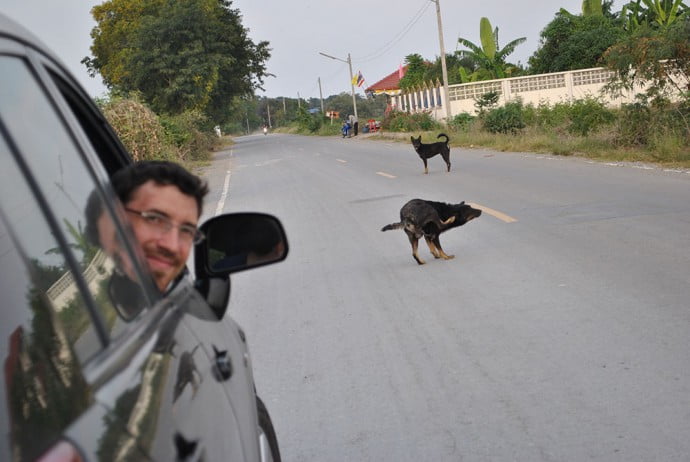
The real problems for me, even more so on the main roads, are the left lane (right for us...) whose surface is very poorly maintained (or repaired "one again" worse than before), full of bumps (sometimes violent) and even impressive holes (some guarantee you a broken front axle if you go over them!), as well as the proliferation of dogs, quite mind-boggling in places. Either they wander, or they cross (like chickens...) or they are downright lying on part of the left lane!!! As most of them are fawn-coloured or even darker, I can't tell you how frightening it is when night falls (sometimes after 18pm...).
So the rule is rather to stay on the right, as long as no one approaches from behind; and at night, remain very vigilant on the probability of an animal wandering here and there, or even lying on the traffic lane.
For police checks, my experience is quite "happy" since on a scooter (solo) I get a big smile (or a stone face, depending) and they don't even let me stop completely. In a car, there are always two of us and I don't even have time to take out my international license before I'm asked to leave. Once, I even got an almost hilarious comment from a cop; translation by my partner: "you're lucky to have her with you" (talking about her sitting on my left); it must be said that it was last October, somewhere between Khon Khen and Udon Thani, with floods everywhere and quite a few diversions.
I love this article, very well written and very well researched. I agree with everything except one.
You say that the police do not only stop tourists and that it is not an excuse. In this case, it is not an excuse, but for having been stopped 9 times in 9 days in the same place in Pattaya. (I always wear my helmet and I have an inter-city license) I can confirm that yes, on certain points they only target Westerners. I stopped for 1 hour and I filmed with the Go Pro.
All tourists are stopped for license and helmet checks (rightly so), and all Thais pass without helmets. Even bikini girls without helmets on two-top sports bikes.
Clearly discrimination that would be immediately condemned in Europe. But hey, they do what they want, they are at home. You just have to know it and smile when you get stopped repeatedly. Once 2 checks 400m apart..
It's sometimes annoying but I now put my license in my pocket, I take it out when I slow down and often they signal me to continue after telling me to stop.
Thanks for the compliment! After the example you give is still separate since you are talking about Pattaya, a tourist seaside resort for example. Similar cases could be found in Phuket or Samui for example, I mention it precisely in the parenthesis following this sentence. The problem with this kind of place is that tourists are indeed easy prey because they are often not in order (intentionally or through ignorance) and therefore easy money in perspective. My remark is valid in the sense that it is not because you are a foreigner that you will be stopped if you ride without a helmet, and the fact of being targeted should not be a problem if you are in order.
Hello Romain,
Thank you very much for all of these articles, absolutely fascinating!
I'm going to Thailand for 2 weeks soon, and I'm spending a few days in Phuket. I'd like to rent a car but I'm wondering how easy it is to park. My hotel is in Kata. What do you think? Is it better to just rent a scooter?
Thank you so much!
Hello,
Let's say that it's always less easy to park by car than by scooter, but having been on the island with my car, it's still quite doable, the main beaches generally have a parking area and given that many people travel on two wheels, there is often space for cars, which are fewer in number.
Hello Romain,
Thank you very much for your very complete and interesting article.
We are planning to rent a car for our trip to Thailand with my boyfriend and I had looked on international rental sites where the prices were around €550 for 2 weeks. When I saw your article I went to ThaïRentACar and I was very very surprised to see that for our 2 weeks the rental price was 1900 baths, which would correspond to around fifty euros! The difference is really huge is the reliability of this site still relevant and the prices are really lower in Thailand or could there be a hidden scam?
Thank you very much in advance for your reply,
Yours.
Hello,
Actually, I think there must have been an error on your part when you did your search, because 1900 baht or 50€ for two weeks of rental is simply impossible. I just did the test and for a typical Toyota sedan, we are more on 13000 baht for two weeks, or 350€ (which is still significantly lower than the 550€ you mentioned).
As such the site is reliable, I myself recently used it to rent a car for next month.
Hello,
We are going to Phuket in February 2023, we do not have a motorcycle license, we had thought about renting a quad, buggy. Does this exist in Phuket?
Hello,
To my knowledge, no... if there are ATVs and buggies, it is for off-road tours of the island with a guide; it is not possible to rent them to travel freely around the island.
Hello Romain and all,
well,….I planned a car trip between Bangkok – Chiang Rai, then plane to Phuket, then relocation between Phuket and Koh Samui in a rental car but before having read your post which, suddenly, makes me a little worried about my trip. I had started from another reading mentioning that the roads in Thailand were in good condition, that there was not too much to worry about…
I would like to have your opinion please. Did I do well?
Thank you ;
Gilles
Hello,
As such, it is especially renting a two-wheeler that I advise against. Renting a car remains entirely possible. It is also towards these (two-wheelers) that you have to be wary and vigilant, especially on the islands where there are many inexperienced tourists driving. As for the state of the roads, I confirm what you have read, it is generally excellent, with many dual carriageways. So no particular worries 😉
(And to add to my post: scooter insurance with very good coverage costs 5000 to 6000 baht per year; it's totally ridiculous and irresponsible not to have it)
What you need to know is that with a scooter rental, you only have the mandatory insurance; in terms of civil liability, that means NADA. You can only take out private insurance (for me, Axa) if you own the vehicle.
A friend on a rented scooter, after scratching the alloy rim of an SUV at Chiang Mai airport, ended up with the local airport police. He was extorted for 15.000 baht, supposedly because all four rims needed replacing. Everyone got a good cut!
The same thing with private insurance, you show the certificate provided; and everyone cringes; they know that the company representative who will arrive will not be intimidated...
So if you rent, clench your buttocks, and pray you don't hurt anyone. And no accidents!!!
Hello Romain,
Thank you for this testimony, it gives a good idea of how we would like to – or not! – travel. We are going with our children to Thailand and we are considering taking a car with driver for more comfort, to do the Bkk/Chiang Mai route, do you have any recommendations on this subject?
Hello,
I just sent you an email 😉
Thanks for the info… Would you have a rental company to recommend to me in Rayong? Maximum coverage obviously…
Goods.
I usually use international companies like Avis, Hertz, it avoids disappointments. Locally you also have VRcarrentVRcarrentVRcarrent.
I don't see my post...but thank you Romain for your quick response..
Hello Romain,
Thank you for this Blog and everyone's comments.
I am going to Thailand for the first time next January for 3 weeks. I will be based in Ban Phe. For my 2nd week I would like to go to Kanchanaburi by car for 3 days and then head to Chiang Mai for 4 days and finally go back down to Rayong. Is it a good idea to do it by car? I have always been very comfortable driving having crisscrossed the roads of Europe for years including "European Thailand" (Sicily) where the driving rules are very random. Is there a carpooling system like we have? or other possibilities to make the different journeys with Thais.
Thank you
Hello,
It is quite manageable by car for experienced drivers, always better (safer) than doing it on two wheels! To my knowledge, there is no carpooling here because public transport is cheap and numerous enough to make it a rather obsolete and unsought service (Thais would not trust each other given their driving style).
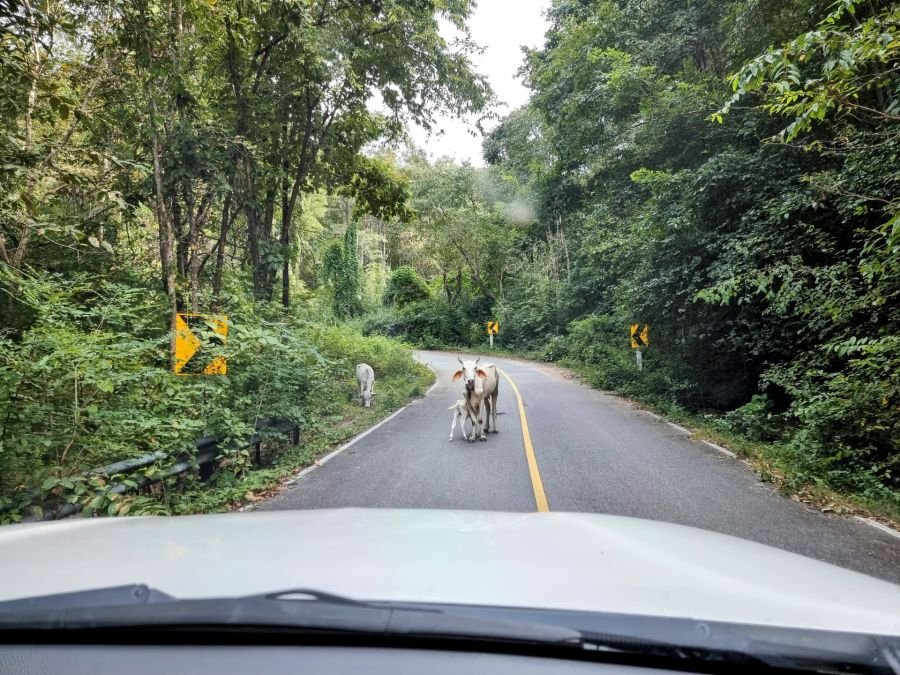
Contrary to what one might think, the Thai "rules of conduct" are not so far from ours. On long journeys, you have to be wary of the "local services", i.e. the way people leave and return to their homes, especially scooters (3 or even 4 on them). Otherwise, you also have to be wary of livestock that are sometimes right on the road (Chang Mai region, winding mountain roads). But overall there are no more surprises than in French peri-urban driving; I would even say that I find them more "placid" than the angry people in France...
Hello, And I who complain about scooters in Taiwan:)) but as you say if they don't honk it's already not bad! I'm going to Chiang Mai on Saturday for a few days of discovery with my husband and I think I'll make do with the red taxis! Your blog is great, bravo!
Thank you very much, have a nice stay in the north!
Thank you for this information, I am going there for a 2 week stay, please can we rent and drive a car with a Moroccan car driving license?
Hello,
Regardless of your nationality, it is necessary to obtain an international license to be able to drive in Thailand, without it you will not be able to rent a car.
if you want to pass your driving test, the theoretical test with 50 questions (45 correct answers required) is not easy; before taking mine, I studied on this site (questions/images strictly identical to the real test) for a good hour: result 49/50 on the test...
http://thaidriving.info/?fbclid=IwAR1n5rGZAVFLhdpe4Hv1C0ABzNi-_7dv-_nTzTTTSPINjrewzeSfr9Xs1Vw
Thanks for this feedback and the link, it could be useful to others!
300 or 500 baht, frankly for a Westerner it's a gift. Especially since we have no excuse not to wear it because we are widely aware, we know the risk well enough, even worse in Thailand than in Europe, this attitude is totally integrated unlike the locals. So even at 1.000 baht the fine is nothing at all.
So we agree on that.
Once, I was pulled over, and the policeman told me in broken English, "I'm stopping you for not wearing a helmet" (I know it's wrong, but now I wear one all the time). I went back to my apartment and showed my ticket to my wife (who's Thai). She said, "You didn't have your driver's license with you." I replied, "No, it's for the helmet." "No, it's 500 baht for the license and 300 for the helmet." Haha, I got ripped off like a tourist.
Good luck Romain
Hello,
I'm not sure of the official amount, although the fines are often 500 Baht, in any case, it will at least have served as a lesson 😉
Hello,
I plan to rent a car to do Bangkok to Phuket in 1 week, maybe 8 days? Is it feasible? And if so, which cities would you recommend for stops?
greetings
Olivier
Hello,
Yes, it is absolutely doable. Basically I would say one step at a time. Phetchaburi, Sam Roi Yot National Park, Prachuap Khiri Khan and Wing 5 Bay, possibly a stopover via Ban Krut, otherwise Chumphon, Ranong, Khao Lak, if time and depending on what you keep in this list that I give you, Khao Sok National Park and finally Phuket.
Hello and thank you for all this information. I plan to rent a vehicle in Krabi. Is the traffic easier in that region? Thank you.
Hello,
It should be fine, the traffic is not as heavy as in bigger cities.
Hello, having spent 2 weeks in the canton of Krabi, the traffic is indeed less dense but the roads are in poor condition and there are lots of animals.
Bonsoir
Great article, very interesting, which should be included in tourist guides. Thank you very much for this!!
A quick question about the car. We're going to try to rent one from an international agency to avoid potential scams if possible.
Now I was wondering how it works in terms of parking?
For example, I leave our luggage and other belongings in the trunk of the car because we're going to travel around southern Thailand with my wife and two children; is there a significant risk of the trunk being broken into to steal our luggage or camera when we go snorkeling?
Another example: is it possible to leave the car for two days near the boats because we're going to an island, like Koh Surin? Or Koh Phi Phi near Krabi? Is there a risk of theft or damage? Are parking restrictions in place? What is the parking system like in Thailand?
If you have any recommendations or experience at this level, I'm interested. Thanks again for the wealth of very useful information.
Hi,
Thanks for the compliment! Indeed, renting from an international agency is a guarantee of a certain quality (such as Hertz for example, which I tend to favor).
Normally, there is no problem leaving things in the trunk, the trick is not to leave them in plain sight, like everywhere, to avoid a certain covetousness. But overall it remains safe and I have already parked my car several times at a dock before going to an island, there are generally adequate and supervised parking lots to do so (paid but not expensive).
When we start thinking that they should do more of this or less of that, we are already in the unconscious approach of the Westerner righting wrongs. We must respect cultural and societal distances. This is why I am talking about reflexes conditioned by our societies, which pose as "learned". We must give this country time to find its own way.
For my part, whether in the north (northern region of Chang Mai), in the surroundings of Burirram, or in other rural regions, I had the vague impression of finding myself in front of a sort of country comparable to France in the 50s. A story of "climate", of atmosphere, according to the way people manage to live or survive.
As for helmets, it should be noted that Thais (and especially Thai women) are still mostly small (women from 1,50 to 1,55m with size 35 shoes are very easy to meet). As a long-time biker myself, I know that getting a size 50 helmet (3XS!) is already quite difficult here. For my 6-year-old son, I had to find one to order and there was nothing smaller. So in Thailand… Not to mention that the products already available in this country are only molded plastic ersatz offering no real protection.
I understand your point of view. As you say, it's like a reflex and when we think that something is better, for the common people, it seems normal to me to want to find these values, rules, in a third country. The key word is patience, because indeed we must give the country time to remedy its problems, which are themselves linked to its culture and its people. I also agree about helmets for children, I just wanted to point out the detail that there are some, without specifying whether they are effective. On the other hand, by specifying that, I also wanted to say that some parents are well aware that their children are exposed to danger and that's nice to see. Thank you for this interesting little discussion!
We must, however, guard against the "colonialist" reflexes we Europeans have, ingrained as we are with the idea that we possess all the solutions to all problems. I would simply like to remind everyone that helmets have only been mandatory in our country for barely 50 years, while our society had just experienced a remarkable economic boom for over 25 years. Let us therefore be wary of our conditioned reflexes.
Poverty is not an excuse but a (part of) the explanation; it is also not to be decried because many families cannot have a car, and are therefore forced to use a scooter (not very valiant by the way...) in the conditions that we know. It will probably take more than a decade for this to change, for many reasons, especially outside the largest cities.
The thing we have in common with these distant peoples (11.000 km from here, which justifies some differences in approach to certain issues) are the sometimes gigantic traffic jams, which strongly encourage people to use a 2-wheeler. Don't forget that helmets are not available for pre-teens and younger children, who nevertheless need to be transported; not so easy to solve!
I don't think I said that we had all the answers. You mentioned the example of France, which may have been slow to react, that's true, but Thailand, with the experience of other countries, should have something to draw inspiration from, it's still 2018... What saddens me the most in this story is ultimately this impression that life, with reincarnation implied, is not that precious...
On the other hand, I would like to correct this, because I see it from time to time, and if helmets for children exist, then it is obvious that there is nothing for the youngest and babies.
Thailand is one of the countries with the highest number of road deaths (per capita). So it is obvious that precautions must be taken. For me, not wearing a helmet was a matter of circumstance.
I also forgot to mention the enormous surprise felt when you see scooters with 3 or even 4 occupants! Without helmets of course, most of the time, or with appendages that do not deserve the name.
But it is downright horrible when you see that the occupants (apart from the driver) are sometimes children, and sometimes very young (even the infant cradled on the arm!). But strangely enough, you end up getting used to it, understanding also that our customs are not (yet) theirs and that necessity sometimes makes law. Poor families are forced to practice this way, they have no choice. Moreover, the police do not flinch at all in the face of such a spectacle. Having been nicknamed "the walking farang" in Buriram, I had the opportunity to exchange a lot (very briefly however) with the inhabitants, and I noticed how much the notion of destiny or karma is present, which encourages the wearing of tattoos or amulets instead of basic safety equipment.
For now, they ride their two wheels in flip-flops, shorts, T-shirts or even in uniform and high heels...
Indeed, a sad track record... The notion of danger is completely abstract, otherwise how could you think of putting your kid in such situations... When I sometimes see 10-year-old kids, the little sister behind going for a ride without a helmet, personally, even after 10 years, I can't get used to it... On the contrary, it irritates me more and more. The excuse of "poverty" is not one (it is often an argument to point the finger at these practices), when I see my neighbors doing it, it is a concrete example, not poor, have cars (and I mean cars) but always prefer the motorcycle, without a helmet and with 3 or 4 to get around the neighborhood...
The helmet is not expensive and what's more, the police had even launched a campaign to offer helmets instead of giving fines. Despite this, the helmet is sometimes on the scooter and not the head (that's how much they want to have their heads exposed...).
On the other hand, you point out an element of response to these behaviors, in fact, there is this notion of karma and of "time will tell" to which we can attach their favorite motto "maï pen raï". I dare to hope that with the years (one can dream), an awareness just as it arrives from the point of view of ecology, will arrive in the collective consciousness.
Hello, and thank you very much for your observations. I am reading you after having been back in France for 3 weeks, it is a bit late…. But I find the same impressions.
Overall, I would say it is a nicely self-regulated mess. I was very surprised by the civility and calm of the drivers of all categories. No aggression, no honking, no hotheads who sneak in wildly, "flexibility" of police constraints (no excessive authority, no radars, simple and basic controls). It's refreshing!
On the other hand, I saw 2 accidents in one month, including one in town which upset me a little: a scooter hitting a pedestrian, in the evening, with the scooter hitting and running.
This did not prevent me from riding a few hundred kilometers on a Honda Jazz and a few dozen on a scooter (Madame's machines...). I rode without a helmet, which for a biker like me was a bit of a betrayal and an excessive risk; not having one on hand, I did without... In any case, I made a mountain out of a molehill about driving on the left and the exotic behavior of the locals, and in the end everything went very well, even in my few rare moments of distraction (the roundabouts in Buriram...) in the early days.
A very bad point for the French administration, pathetic in every way in our hyper-computerized era, which takes much longer today to issue a passport and even worse an international permit (6 weeks!!!)
Hello and thank you for this testimony, I obviously do not congratulate you for having ridden without a helmet... Riding a car is less of a challenge, because it is much safer, compared to the permanent exposure to danger on 2 wheels, personally, I bought my own helmet when I intend to rent a motorbike somewhere, like that, not only do I have a helmet, but it is a full-face helmet, because if in Bangkok we still see quite a few people with helmets over the years, few really deserve to be worn as they are so ineffective... and few attach them because we have the impression that they don't give a damn about being protected...
I can't count the number of incivilities I come across every day and while it's true that all this is done "calmly", it's exasperating to see basic safety rules so easily flouted and ignored, with the police being the first culprit in this story because they are incapable of imposing these laws on their stubborn people. When I see motorcycles going through a red light when there are like 5 seconds left to wait, I can't understand what pushes them to take this ridiculous risk, these normally calm, peaceful people literally transform behind the wheel into something worse than Parisians... impatient and dangerous.
I myself saw an accident just yesterday, which adds to the long list that I have seen parade over the past 10 years, including deaths. I remain hopeful that the government will finally open its eyes and make itself heard, we do not joke with the lives of others.
Hello,
Thank you very much for all this information, very interesting!!
A quick question: you didn't mention speed?...
I thought Thais drive fast but I saw in a comment that they have a "smooth and quiet" driving style (?)
What about the road and direction signs? Is it easy to find your way?
Hello,
Indeed, good suggestion, the fact is that speed is quite subjective in Thailand. The "official" speeds are so unsuitable that they are thinking about harmonizing the limitations (to date we find 80 in town as well as 80 on the highway...). Overall it remains reasonable but you will always have a certain number of "fast and furious", motorcycles included. On the other hand, no, Thais do not have a smooth or quiet driving style...
The main road signs are always indicated with a Latin alphabet so you can find your way around (even if sometimes there is a lack of indications at crossroads, a GPS is not too much...) The road signs are quite explicit so you should be able to find your way around.
Thank you very much
Hello
Great article that is quite scary, if I had read it before leaving, I might not have rented a car.
But I rented one online from a major rental company, where everything was in order! I drove normally, like a leisurely and courteous tourist.
I discovered their driving style, where all two-wheelers and four-wheelers overtake on all sides. Zebra crossings are used more for overtaking in third position than for dividing the road in two; when there are other crossings, they simply overtake on the opposite carriageway, solid line or not. But everyone plays along and moves aside to let others pass. They turn left at red lights, giving priority to those with a green light…
Their driving, although outside the rules, remains flexible and calm for the majority, the roads are wide and in good condition (often better than at home) even in remote areas, but work zones appear that are not marked with nice holes.
In short, by keeping your eyes open; pay attention to what is happening behind you on both sides and from the front in the opposite direction, even on bends, it works if you stay cool.
Hello,
That pretty much sums up the driving style in Thailand 😉 The fact is that I mainly emphasize the unpredictable aspect of 2 wheels and therefore advise against using them, because they are much more exposed to dangers on the roads than in a car. And indeed, renting from an international rental company is the best solution to avoid scams or other problems.
Hello Romain
I am discovering your site… very rich!
Currently, I am looking more specifically for information about using a scooter as a family. That is to say with one or two children as passengers (a subject that is rarely discussed on the web). With basic caution, what is your opinion/advice for going on a scooter road trip for a few days with the family, in Thailand in particular (e.g. the Mae Hong Son loop), in Asia in general?
Thanks for the tip and maybe see you soon.
Manu and his troop
Hello,
Well even assuming you have the proper license, I don't really recommend it, according to my article. I consider the exercise quite risky even if tempting, especially this road in particular, known for its (very) many bends.
Hello,
I have a B license + international license. You are only talking about renting a 110/125cc motorcycle scooter.
What about 50CC scooter rentals?
by the way, is it done to rent a car at point A to return it to point B? if this is a regular practice.
merci beaucoup
Hello,
I'm not talking about 50cc rentals simply because there aren't any in Thailand... the minimum will be 110 or 125cc.
If you take large international companies like Avis, Hertz etc… it will be entirely possible for you to rent at point A and return the car elsewhere.
I think your information relates to driving a car because when you see all the kids who go to school on motorcycles and don't have a license (1 month in prison) seems excessive to me and the fine is 500 baht.
My comment is written following events experienced personally
No, my information is valid regardless of the type of transport. This is a reminder of the laws for foreigners wishing to rent a vehicle. Of course, many Thais drive without helmets, without having the age limit and this, in fact, often without being worried by the police (even if the checks are still more frequent, especially in town). This is not a reason for tourists to do the same!
Thank you Romain.
Ouch, I just saw your article, it's scary 😉 So how do you know what the best solution is, renting a car or traveling by taxi in this very expensive country where you can't criticize the king, show your feet, enter temples barefoot, (that's what I learned about things NOT to do in Thailand xD); I'd like your opinion on this so I don't end up back in Europe covered in neon green. Is the food decent? I've heard about hepatitis A; the doctor mentioned it, and I'm thinking, "Uh oh, I've been eating McDonald's for 10 days!" I've read comments about rental companies; apparently, they're all "grumpy" and charge extra despite their reasonable rating of around 3,5/5. When they overcharge for a service, I unfortunately get a bit angry in that kind of situation. So, to avoid that kind of situation, and well, I want to take it easy there, not end up as a permanent resident in jail. Because nobody likes being ripped off, I think. So, to sum it up: As a European arriving in Bangkok, I see the opportunists showing up to rake in the cash (I know it happens in every country, but still). I've already looked it up; it's about 150 km from Bangkok to Pattaya, about a 2-hour drive. I've heard several things Prices have already dropped from €75 to €25. Do they accept euros? Or do I need baht to pay for the ride? Any additional tips would be appreciated. Thanks.
Hello,
You shouldn't leave feeling scared though... Sure, there are known scams, but that doesn't mean it's commonplace. On the contrary, entering temples barefoot is something to do, not something to not do 😉
It depends on the temples, but what you need to remember is that for the main temples, mainly those of royal rank (Wat Phra Keaw, Wat Arun, Wat Pho, to name a few) you must visit with your shoulders covered (t-shirt, no shawl for women) and your legs covered, especially true for women and also for men concerning Wat Phra Kaew (within the Grand Palace)
If you go with this preconception about food in Thailand, you're in for a bad start, it's one of the most famous in the world after all... The hepatitis A vaccine is still recommended but not obligatory that said.
For rental companies, if you are talking about cars, then there is no problem using international companies like Avis, Hertz etc. No scams involved, it is not in their interest. On the other hand; be careful with driving in Thailand which is quite particular (no longer drive on the left)
You can find taxis from 1000 Bahts to Pattaya (which is not the best place to avoid profiteers by the way…), which is a little less than 30€ at the current conversion rate, and no, it's Thailand so only bahts are accepted…
Good evening, yes, oops, about the bare feet, yes, I made a bit of a mistake trying to cram everything into one question. First of all, thank you, this is very useful information. As for the food, we'll see, I'm a bit of a spoiled brat about that, but if it smells good, I'll still eat their dishes (unless it's insects, of course). Regarding the cars, I looked at your link above, I booked the hotel through Trivago, and I have to pay the amount in baht on arrival. Well, I admit I haven't read all your posts, there are a lot, but when I arrive, I'll certainly ask a couple more small questions. Thank you already for this very kind reply.
Hello,
Quite frankly, insects are more of a tourist thing than an everyday dish, clichés die hard in Thailand...
Hello, and thank you. Reassuring and essential article.
I'm on a mission for 1 year in Chiang Mai, after the scooter and a stunt (with the helmet, and you're right to insist, even if some people think it's freedom and cool to do it without, but when you kiss the asphalt, you'll be less smart especially with the risks here)
Be careful here with the International Driving Permit, which is valid for 3 years, in Thailand it is only valid for 1 year.
You are talking about getting the “Thai” license, do you know about this process and where to do it?
Other things do you have any tips or other things for Visas because at the Thai embassy in Paris it's just a disaster and long.
For those who would like information I am also here, I stay in a Condo in Chiang Mai and know this city a little. So do not hesitate it is always a pleasure to meet people passing through or expatriates. Let's help each other.
Other points: in this period of Mourning, respect and be discreet.
@+
TheFrenchThai
Hello,
Thank you for this information and your feedback. For the visa, it is easier to obtain from neighboring Laos, I go to the Thai consulate in Savannakhet.
Sawadee Kap
That’s it, my administrative procedures are finished:
Works permit OK
Non-immigrant visa OK
and car & motorcycle permit OK
So for the permit and it is preferable if you stay more than 3 months in Thailand
Steps to follow and mistakes to avoid
The international permit with the 1968 convention is not valid in Thailand, you need the 1949 one... yes I know!!
Two possibilities
or take 1 day of practical and theoretical exam, with written test and driving (in Thai and in English if you're lucky)
or carry out administrative procedures:
So the best thing is to have your license translated into Thai and validated by the French authorities, embassy or consulate
800 THB for the translation and approx. 1000 THB for the stamp that makes it official
Have a medical certificate less than 1 month old, you can do it in hospitals approx. 1 hour and 200 THB
General question and simple exam
Then go to the Provincial Land Transport Office, open Monday to Friday 8 a.m. to 18 p.m.
be patient
Have a copy of all your documents and forms to fill out upon your arrival
then you would be called he has shifts at 9:00 a.m., 10:00 a.m. and 13:2 p.m. count XNUMX hours minimum
Color test to see if you are not color blind, then 1 hour of film on traffic rules (yes...yes there are some promised, since this film... I confirm they do not drive well at all.. lol)
Then you take a ticket to get your permit and this can take a long time depending on the number of people in front of you and when it is your turn you have to pay 205 THB and 105 per permit and 100 THB to take the photo and the permit
Then you take a ticket for the completion of your drive license
And you have the Grail
I hope this will be useful, and good luck to you, and above all, enjoy discovering this beautiful country.
Do not hesitate if you have any questions and thank you Romain for all your recent articles and others it is always a pleasure to follow you
Thank you very much for this very comprehensive feedback and thank you for the compliment!
Hello,
very well done and nice article, but you don't talk about "IF we have an accident"!?
What happens IF we have an accident? We hear things that are scary, especially if there are injuries... (risk of prison, etc.)?
Hello,
Thanks for the compliment! That's right, I don't talk about it. Basically it's because I think it's better to avoid having any 😉 It's a section that I should add indeed.
Hello, congratulations on your article about scooters! Everything is very clear, with a touch of humor. However, I didn't understand where one can obtain an international driving permit, in France or Thailand? Also, I'm 65 years old, and my driving style will be quite leisurely (on the far left). Is this the safest approach? Thank you very much for your valuable advice. Claude Lampson
Hello,
The international permit is obtained at the prefecture closest to you, in France. Let's just say that caution is advised anyway, it's not necessarily inconvenient. Enjoy your stay and be careful 😉
Very good article! Indeed, driving in Thailand is an art but I find that there has been a great improvement in recent years… Even if the roads are not yet as beautiful as our French highways, they are gradually improving in quality 🙂
“Little by little, the bird makes its nest”
Thank you! The road network does not include motorways but many 2x2 lanes (sometimes even wider), and overall the networks are pretty good anyway. I have noticed that recently many are being redone and widened. This is a good thing, unfortunately, it does not change the behaviour of users...
You don't say a single word about the necessary motorcycle license.
In France, people who have their A1 license as an equivalent to their B license (i.e. without having passed a specific A1 exam) cannot have this 125 cc license validated on the international license. But without this license you are breaking the law if you drive a 110 cc in Thailand and hello the problem with insurance and international assistance.
Furthermore, it would seem that it is even the A license, and not simply the A1, which is necessary, I am waiting for details from the Tourism Office of Thailand.
First of all hello.
No, indeed, I am not talking about the motorcycle license. It is true to say that the French B license, allowing you to drive vehicles up to 125cc is not recognized here in Thailand, but this is especially true for the fact of transcribing your French license into a Thai license, which requires retaking the code and the (very basic) driving test, which is not necessary for the car license where only the code is necessary.
The A1 license is a very French specificity, as such, from an insurance point of view, it would indeed be mandatory to have a motorcycle license, therefore A, in France, in order to be transcribed on the international license. From a police control point of view, the international license, together with the French license, is sufficient.
Except that I am not talking about the behavior of local police officers during a check, but about Thai law. Since then I have had confirmation from the National Tourism Office of Thailand that the A license is essential. Following my approach a note was added to their site: http://tourismethaifr.com/news/Actualites_d.tpl?SKU=10856. If someone without a license A drives a scooter in Thailand and injures, or worse kills, someone, he will not be covered by his liability insurance, nor by the legal protection of his international assistance since he was an outlaw. And that's where hell begins...
Ok, thanks for this clarification so… A word to the wise for those interested in renting in the future.
Hello, are you sure that a B license can't be converted to a Thai license without passing the theory test? (in the case of a non-immigrant visa after more than 90 days in Thailand)... Thais don't differentiate between engine sizes... a Thai motorcycle license allows you to drive any motorcycle, as far as I know
Hello,
Since I'm coming back from getting my license done, no, I confirm, you have to take the code, the test is not to be done on the other hand (driving test I'm talking about, because there are reflex, vision, color tests to do) except for the motorcycle, because the basic B license certainly allows you to drive up to 125cm3 in France, but in Thailand it is not recognized... So I had to take a driving test (basic all in all). After that remains my experience here in Bangkok...
You forgot one very important thing before you left:
check if you have your 1001 Talismans from the temple that your Somtum saleswoman's grandmother frequents.
Ah ah ah! except that it doesn't concern tourists... for whom the article is originally written 😉